While San Francisco’s tech community frets over AI-driven job displacement, we have more to fear from misguided government welfare policies.
San Francisco allows thousands of people with substance-abuse problems or mental-health issues to live on the streets.
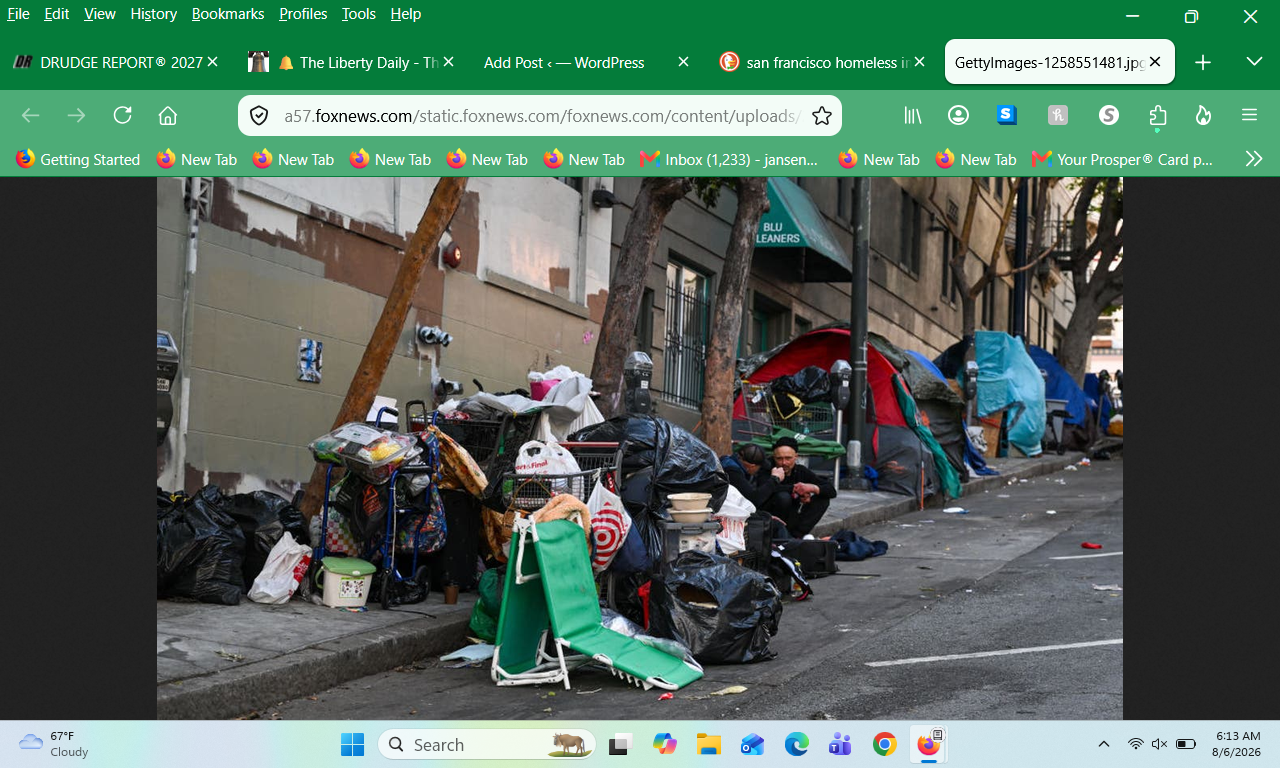
No city better captures the contradictions of twenty-first-century America than San Francisco. The capital of the AI revolution is also a place where open drug use, mental illness, and public disorder have become banal features of daily life. Increasingly, the two realities seem to be bleeding into each other.
What explains the flurry of concern in San Francisco over the supposedly imminent creation of a “permanent underclass”? The phrase, prominent in tech circles on X, refers to the vast, impoverished caste that many fear AI automation could create as jobs disappear and wealth flows increasingly to owners of capital. Murmurs about the permanent underclass began as a kind of inside joke in San Francisco—a winking reference to the awe and anxiety sweeping the tech industry as AI models steadily improved and engineers realized that they would either embrace the new tools or get left behind. As one popular meme put it: “You have [blank] months to escape the permanent underclass” (where the blank is a stand-in for your “artificial general intelligence timeline”—or how long you think it will take the models to automate almost all work)
The meme was then boosted by executives at major labs. Anthropic CEO Dario Amodei argued in a January 2026 essay that AI could leave people with lower cognitive ability in an “unemployed or very-low-wage ‘underclass,’ ” and, a few weeks later, Microsoft AI chief Mustafa Suleyman predicted that most professional tasks that involve “sitting down at a computer” would be fully automated within the next year. The specter of mass unemployment is now the subject of sober discussion in the New York Times, where top Democratic strategists assure us that they’re working on campaign messaging around a “federal jobs guarantee.” Others see AI as the logical impetus for instituting a Universal Basic Income (UBI).
The straightforward explanation is that Amodei and other big-labs spokesmen are earnestly trying to warn us about the coming upheaval. There is good reason to worry about the consequences of dramatic economic transformation. Prominent tech companies like Meta, Coinbase, and Block have all recently announced extensive layoffs, ostensibly because they can now automate many internal processes. Model capabilities continue to improve at a remarkable clip: an internal OpenAI model in May solved an 80-year-old problem in discrete mathematics, for example, and one of Anthropic’s top engineers says that he runs thousands of agents around the clock to perform work that not long ago required massive teams.
Still, it’s unclear whether an AI jobs apocalypse is really underway. Tech layoffs may simply reflect a correction from zero-interest-rate-era overhiring. Unemployment among college graduates, a leading indicator of labor-market strength, is hovering around 5 percent—slightly above 2023 levels but still well within normal range. Some tech CEOs, like Aaron Levie of Box, have even said that they’ve created lots of new job categories because of AI. In the wake of growing political pushback, heads of major labs have begun walking back their warnings about job loss. “I don’t think we’re going to have the kind of jobs apocalypse that some [other AI companies] advocate,” OpenAI CEO Sam Altman said this spring. “That is an area where my intuitions were just off.” Were they just sowing fear about job loss to facilitate their fundraising efforts?
Perhaps, then, it’s more useful to think of the “permanent underclass” as an expression of white-collar status anxiety. As influential Bay Area blogger Scott Alexander observed, the meme spread among rank-and-file tech workers who seemed worried that they were “just bourgeois well-off rather than future oligarch well-off, and that only true oligarchs will have a good time after the [technological] Singularity.” This interpretation squares with an X post from a prominent venture capitalist who wrote that concerns about the permanent underclass come up frequently among young tech workers worried that their well-paying but not extraordinarily lucrative jobs won’t exist in a few years; they envy peers at major labs who have made enough to retire.
But the permanent underclass meme does not just suggest that some people will lose purchasing power. It suggests that they will be irrevocably relegated to misery and destitution. There is a real-life analogue to this class in San Francisco: the drug-addicted and mentally ill homeless allowed to decay on our streets. Maybe the resonance of the “permanent underclass” meme comes less from concerns about downward mobility and more from the experience of passing a half-naked man smoking fentanyl on your way to work; or watching a swarm of drug dealers cater to wheelchair-bound addicts from the window of a self-driving taxi; or repeatedly pressing the “call for assistance” button in front of a locked toiletries display at a pharmacy. These experiences have become banal in many American cities, but their banality is especially striking in San Francisco, the hub of the most consequential technological revolution of our time. The permanent underclass already lives among you—are you just one twist of fate away from joining it?
This fear animates a short story, “The Company Man,” that went viral on LessWrong, a community blog popular among AI researchers. In it, a man who develops algorithms for a short-form video company gets promoted to work on “The Project,” the internal name for an effort to build a recursively self-improving AI. The leader of The Project, motivated by a fetish “for the abstract notion of intellectual achievement itself,” describes it as an attempt to instantiate a kind of machine god. When The Project succeeds and superintelligence is achieved, the researchers are all fired, and the protagonist exchanges his money for a hit of fentanyl from a nearby junkie before joining “the zombies,” as he calls them, in their semiconscious misery. This is the permanent underclass nightmare in its fullest expression.
The story is, of course, stylized and exaggerated. But its popularity suggests that it struck a nerve and reflects something of Silicon Valley’s anxieties. There are lots of familiar AI dystopia tropes here: the “zombies” are blissed out and wire-headed (as humans might become if they offload all their work onto machines); the endgame of AI research is immanentizing a perverse eschaton; and the barrier between the two spheres is vanishingly thin. As the protagonist tells us at the outset: “To get to the campus, I have to walk past the fentanyl zombies.” In the real world, the condition of an anxious engineer is nothing like that of a homeless addict on the verge of death. But there is a sense, in this story and in the permanent underclass meme, that the misery on our streets might be evidence, or a portent, of coming doom.
And yet San Francisco’s existing underclass is largely the product of state policy. The group includes at least 8,000 people who, at last count, were living on the streets or in “makeshift shelters” like tents and cars. It also plausibly includes some portion of the roughly 30,000 people housed in single-room occupancies (SROs), slum housing concentrated mainly in the Tenderloin, Chinatown, and Mission neighborhoods. Almost all those on the streets, and many of those in state-subsidized housing, have severe substance-abuse issues and mental illness.
The misery of these people is actively encouraged and supported by the state, both indirectly through tolerance of shoplifting and public disorder and directly through a generous array of cash and in-kind benefits. These include monthly direct cash payments, access to food stamps (easily parlayed into cash), and free needles, foil, and lighters.
Many of these people would benefit from some form of temporary involuntary commitment. But California began dismantling its state hospital system in the 1960s. In its place, we have exorbitant or ineffectual tools that include temporary psychiatric holds at hospitals, “full-service partnerships”—in which social workers, psychiatrists, and addiction counselors work one-on-one with homeless people to do “whatever it takes” to treat them in the streets—and (most commonly) outright neglect.
The authoritative account of California’s failed approach to dealing with its hundreds of thousands of nonfunctional, mentally ill residents is Alex Barnard’s 2023 book Conservatorship, which surveys the quality of care that California gets for the billions it spends annually on the homeless. Though sympathetic to the thrust of deinstitutionalization, Barnard nonetheless concludes that California’s status quo is untenable. The state has “abdicated its authority” over the addicted and severely mentally ill, in part by making it so difficult to compel them into care.
California politicians have been promising for decades, with varying degrees of seriousness, to fix this situation. In 2002, then–San Francisco supervisor Gavin Newsom sponsored the “Care Not Cash” initiative, which reduced welfare payments to the homeless in exchange for access to shelter and supportive services. More than two decades later, the city’s unsheltered homeless population is roughly unchanged, and the homeless can receive as much in inflation-adjusted welfare payments as they could before Care Not Cash. The state shows little sign of the political will needed for dramatic reform. Over the past few years, California has invested tens of millions of dollars in alternative mental-health courts (“CARE Courts”) that provide suggested treatment plans for psychotic individuals in hopes of preventing their admission into involuntary conservatorships.
Under its new mayor, San Francisco has also opened a sobering center, where officials hope to send people arrested for openly using drugs. Authorities have emphasized that addicts brought to the center are free to leave whenever they wish and will face no criminal charges for public intoxication. Even so, the initiative has sparked progressive backlash. Jackie Fielder, the city’s most progressive supervisor, is under investigation by the city attorney’s office for allegedly leaking a confidential report about problems surrounding the center, presumably in an effort to kill the project. (Fielder took a three-month “mental health–related” leave of absence after the investigation opened.)
The persistence of San Francisco’s drug-addicted underclass offers a warning. While offshoring and deindustrialization may explain some of America’s broader social dislocation, the city’s street disorder is more immediately the product of policies that enable addiction, dependency, and dysfunction. Those who believe that future AI-driven dislocation could be addressed chiefly through unconditional subsistence payments should take note. Too often, that cure proves worse than the disease.