Category Archives: Government

THE PRESIDENTIAL MOTORCADE IS QUITE A SPECTACLE OF PROTECTION!

The Fascinating Anatomy of the Presidential Motorcade

Going inside the safest and most dangerous place on the road.

photo illustration of motorcade

Photo by Mallory Short / Mark Elias/ Justin Sullivan / Getty Images

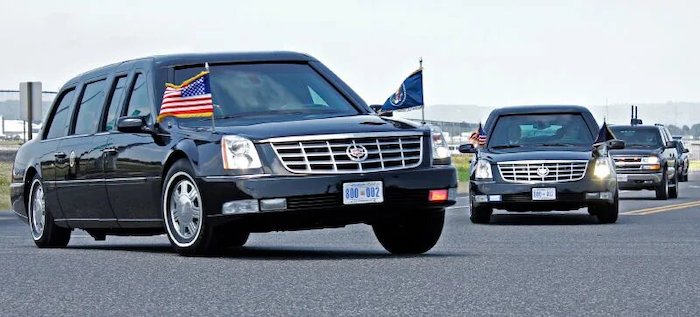
The Presidential Motorcade is both the safest and seemingly the riskiest convoy on the planet. This globe-trotting fleet of vehicles is basically a rolling, armored White House, complete with its own contingency response force, communications office, press corps and medical facilities.

33.jpg

The Presidential Motorcade readly to roll. Photo by AP

The Presidential Motorcade is built from a fleet of both custom and sometimes rented vehicles. A finite amount of Presidential limousines exist, with between 16 and 20 being an estimate. Careful planning and a logistical symphony has to take place in order to pre-position the most capable (and usually newest) vehicles based on the threat level and operating environment at each destination.

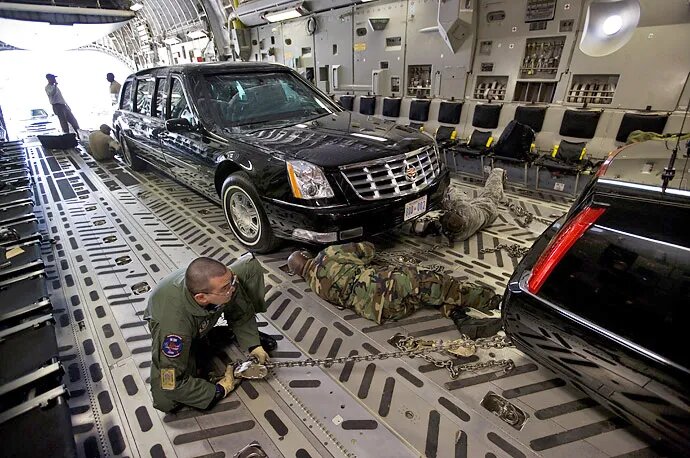
It is not uncommon of for the President to visit three separate cities during a single day, especially during campaign season. That means three separate motorcade detachments need to be forward deployed to those cities. This is done via USAF heavy-transports such as C-17s, or on some occasions, a single C-5 Galaxy.

555.jpg

A pair of Presidential Limos are loaded onto a C-17 Globemaster III. Photo by USAF

In addition to the Presidential Motorcade being forward deployed to where the President is heading, it is now usually customary to deploy a pair of Presidential Airlift helicopters to the destination regardless of if they are used or not. These could be either a pair of “Marine One” VH-3D Sea Kings or VH-60N Black Hawks belonging to Marine Helicopter Squadron 1, otherwise known as HMX-1. The unit is located along the Potomac River in Quantico, Virginia. Like the motorcade, these choppers usually arrive via USAF heavy transport and they are often not seen outside of a local orientation and maintenance check flight that occurs days before the President arrives.

1123.jpg

Marine One VH-3D and support MV-22s, all belonging to HMX-1, as well as the “The Beast,” seen during a Presidential visit to Manhattan. Photo by Reuters

Their main mission is to offer the White House and the Secret Service a contingency presidential transport solution in an any number of types of emergency or special circumstance.

Multiple USAF heavy transports are required to facilitate a single presidential visit, and those flights come at a steep cost.

5565.jpg

“The Beast” rolls across the apron with C-5 Galaxy transports in the background. Photo by AP

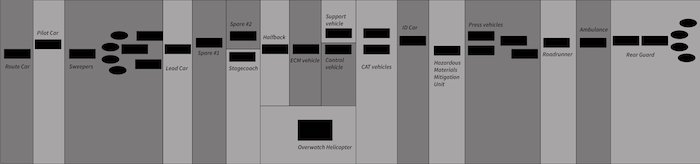
The Presidential Motorcade consists of a wide variety of vehicles. The exact configuration changes depending on the mission and the assets at hand, but the basic layout diagrammed in this story is fairly customary. Sometimes extra cars are added in different positions, and just because the Presidential limousines are in motion, the President isn’t necessarily inside one of them. The protective detail of the Secret Service are masters of what they do, and they know how to optimize their capabilities against a potential enemy’s weaknesses and strengths.

Generally the Presidential Motorcade is made up of the following components:

motorcade_vector_inline.jpg

The key components of the Presidential Motorcade.  Photo by The Drive

Route Car & Pilot Car

The Route Car runs minutes ahead of the Presidential Motorcade, presumably checking the route and providing guidance for inbound “sweepers” [see below] while also providing intelligence to the entire motorcade. The Pilot Car does the same but runs a minute or even just seconds in front of the motorcade. It may be accompanied by motorcycle police to cut off key intersections and highway overpasses.

Sweepers

These are usually throngs of police on motorcycles and in patrol cars as part of a Presidential Motorcade. They deploy in front of the motorcade, clearing the way so that the motorcade’s speed can remain as consistent.

Lead Car

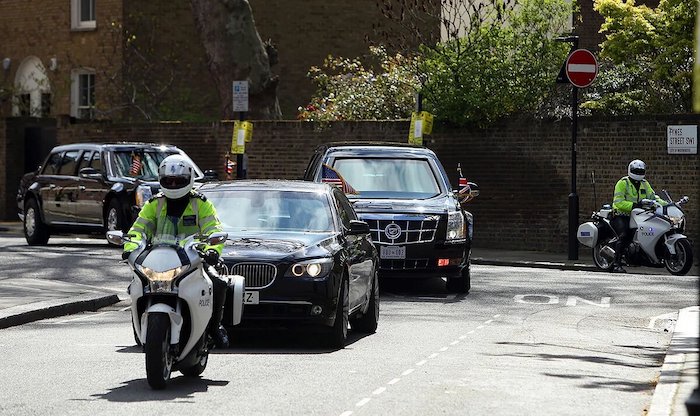
The lead of the core of the Presidential Motorcade formation. It works as a guide and a buffer for what lies ahead. It can be a Secret Service Suburban, a local marked police car, or really any car the Secret Service chooses—such as the BMW pictured.

ap_838718767385.jpg

A BMW lead car with the Presidential Limo in tow makes its way through tight streets in the UK.  Photo by AP

Presidential Limousine: Code Name “Stagecoach” or “Spare”

The Presidential limousine rides at the very center of the motorcade “package.” What appears to be a very heavy Cadillac is really an extremely survivable and luxurious armored car. “The Beast” as latest addition to Presidential limo history is known, is outfitted with a plethora of unique capabilities and countermeasures, each one aimed at keeping the President safe and allowing him to rapidly evade danger during an attack, whether direct (ambush) or indirect (gassing a city, etc).

dadaddcca.jpg

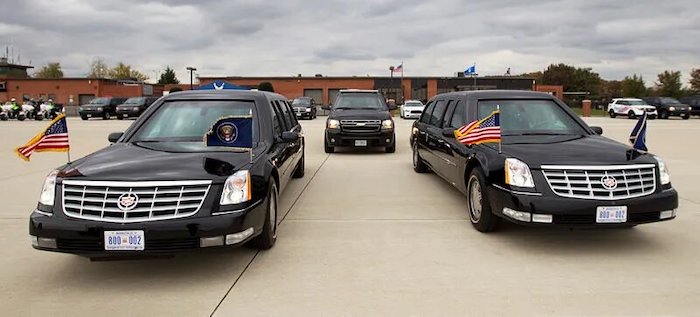
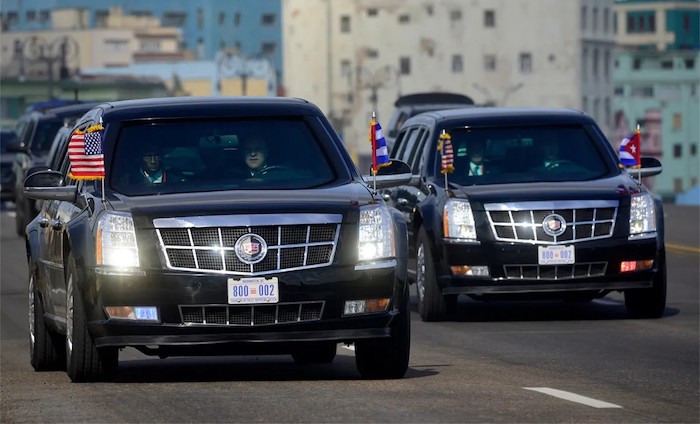
A pair of 2005 DTS style Presidential limousines in the motorcade. Photo by Paul Carter

The Beast’s defense capabilities include top-level ballistic armoring, night vision/infrared driving systems, a sealed cabin with an independent air supply capable of enduring a nuclear-biological-chemical (NBC) attack, and even a supply of the President’s blood type. Other rumored features include infrared smoke-screen and oil slick deployment capability, as well as tear gas dispensers, and, frankly, just about anything you or Tom Clancy can think of. All of this is in addition to a state-of-the-art communications connectivity system, including internet and secure telephone communications.

ezgif-29161549c03a43.jpg

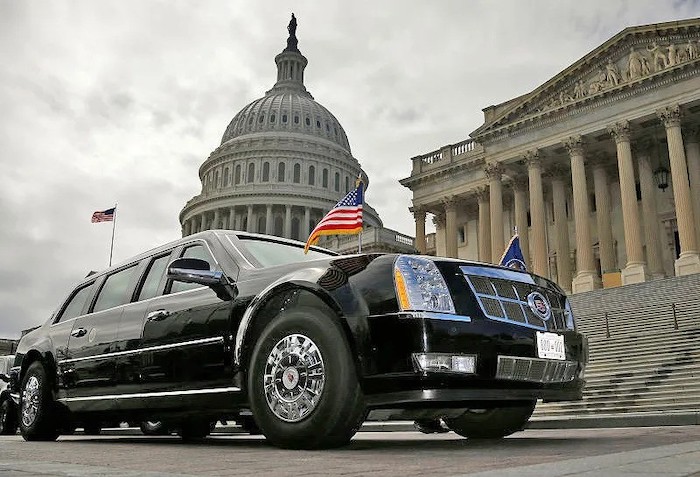
“The Beast” at the Capital steps. The type was introduced in 2009. Photo by AP

“The Beast,” which was introduced in 2009 during President Obama’s inauguration, has an imposing stance, and looks like the offspring of a Cadillac STS and an MRAP. For all its obvious benefits, this cool-looking Presidential hauler has its detractors. The limousine is more of an armored assault truck than a car, yet it does not benefit from an assault truck’s ground clearance. It can be tricky to maneuver on tight city streets, is said to be extremely heavy, and has broken down while on high-profile missions. To be fair, the older model was not immune to breaking down either.

ezgif-80cf7da1290088.jpg

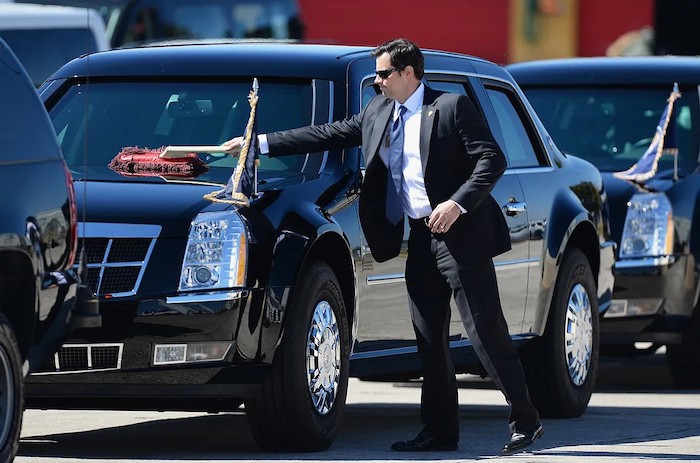
A secret service agent dusts off The Beast while on a mission. Photo by AP

There are a finite number of these new “Beast” cars and oftentimes the President will be seen riding in a 2005 Cadillac DTS inspired Presidential limousine, or even one of the Secret Service’s up-armored Suburbans that are regularly used to move the Vice President and other VVIPs around.

ezgif-80b84a27824055.jpg

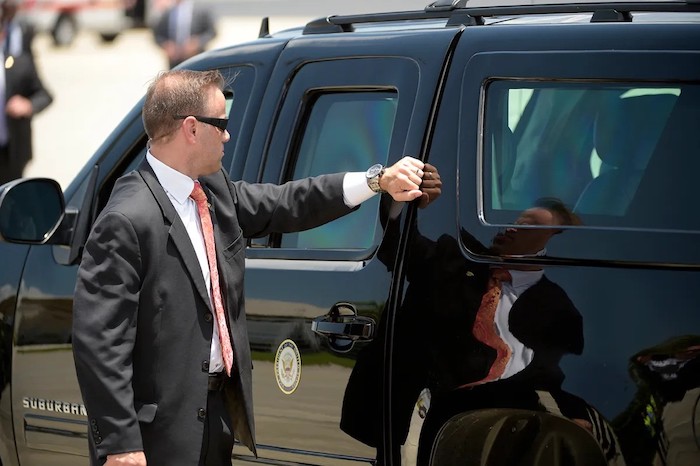
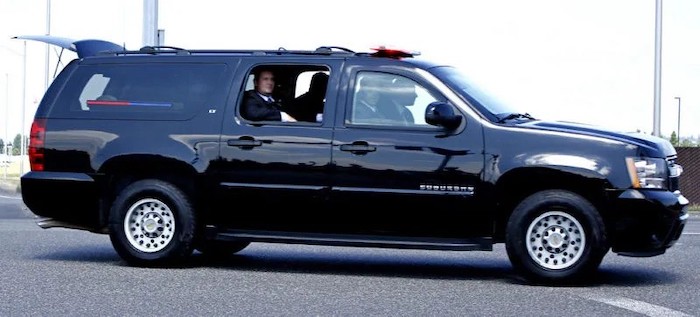
One of the Secret Service’s armored Suburbans. Photo by AP

In fact, when traveling overseas to especially dangerous locales with questionable road conditions, armored Suburbans can make up almost the entire Presidential Motorcade. This was the case in Iraq, where up-armored Humvees were used as ‘sweepers.’ The sticks attached to the top of the Suburbans in the picture below are the aerials for improvised explosive device jamming equipment.

ezgif-86ed736c4b9def.jpg

Obama heads to Camp Victory in Baghdad. Photo by White House

The ‘Stagecoach,’ the name for whatever car the President is in, is the whole focus of Presidential Motorcade. Everything is centered on making sure that car makes it to its destination. In addition to ‘Stagecoach,’ at least one identical car always accompanies it, and sometimes many more. These cars, known as ‘Spares,’ are used as a backup and blocking vehicle should POTUS’s vehicle have a mechanical issue or is attacked, as well a serving as decoys.

While the motorcade is in motion, highly trained Secret Service drivers execute a classic roving ‘shell game,’ weaving Stagecoach and Spare, or Spares, in and out among each other so that a would-be attacker would have a tough time picking the car actually containing the President. The Presidential limousines even have identical plates.

ezgif-82d96ce584b88a.jpg

A pair of “Beasts” act as Stagecoach and Spare. Photo by AP

The Secret Service agents that drive the Presidential limousines are among the best and most trusted personnel in the institution. They go through constant drills at the Secret Service’s sprawling James J. Rowley training complex, including defensive and offensive driving courses, as well as elaborate life-like tactical scenarios that bring all the elements of the motorcade together to defeat or evade a whole slew of possible threats.

ezgif-6428c24ccba126.jpg

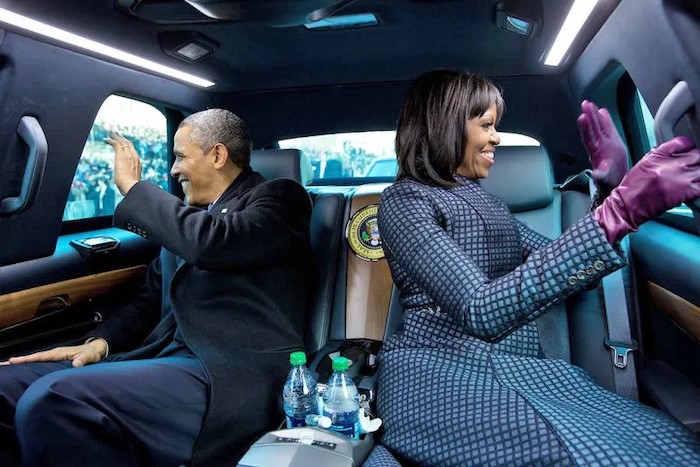
President & First Lady seen in “The Beast.” Photo by White House

Currently [this article was written in 2016], the Secret Service is working on a new Presidential limo that should be ready for the 2017 Inauguration, and will likely replace the 2005 DTS-style armored limousines that will be over a decade old.

ezgif-6423b9f1e925f9.jpg

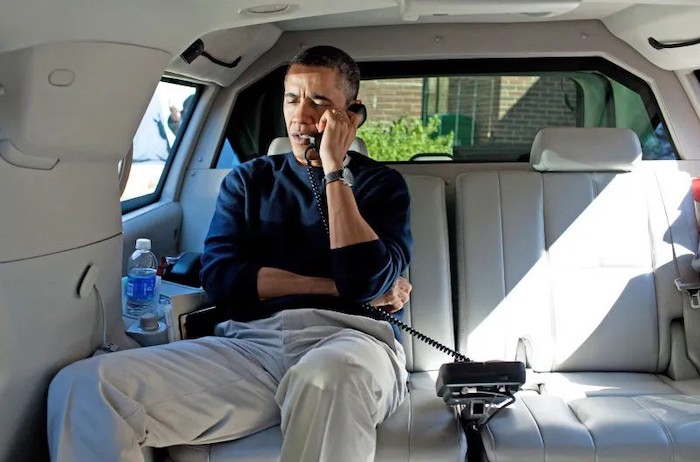
President making a call in a Secret Service heavily armored VVIP Suburban. Photo by White House

Presidential Security Detail SUV: Code Named “Halfback”

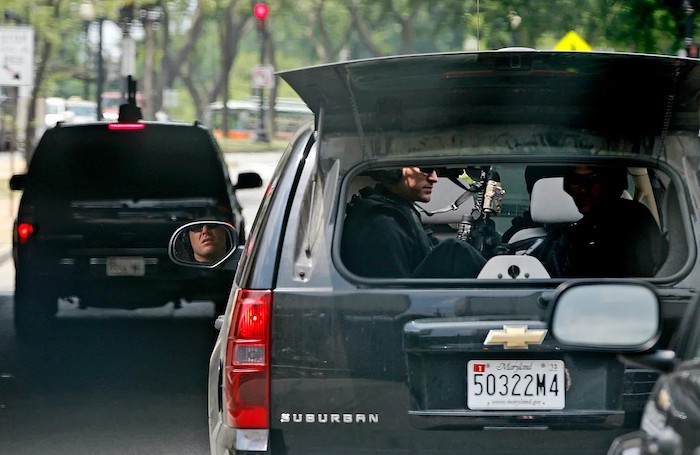
Halfback is the following car for Stagecoach and Spare(s), and it carries the President’s Secret Service protective detail. Usually this vehicle is a specially outfitted Chevrolet Suburban with police lights mounted on a light bar, in the interior windows, and in the grill. This is basically the President’s first line of backup should something occur while en route, and it will follow a pre-planned set of defensive driving and VIP protection tactics based on a long list of contingencies. Rear-facing third row seating usually has at least one overtly armed Secret Service Agent sitting with the window or tailgate open.

ezgif-5b9b32d97af3c8.jpg

The President’s security detail riding in Halfback. Photo by Paul Carter

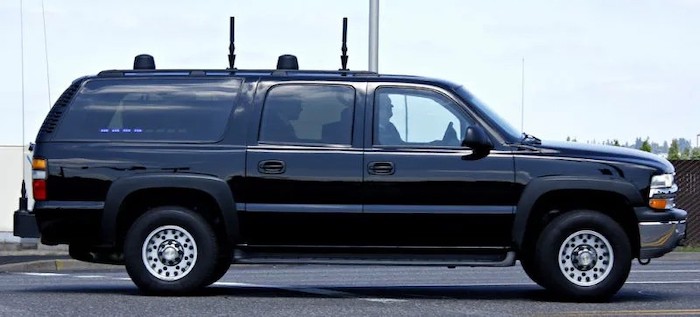
Electronic Countermeasures Vehicle Code Name: “Watchtower”

This vehicle has large vertical aerials and domes on its spine and actively jams communications and remote detonating devices. In some configurations, it may also work at detecting incoming projectiles and small unmanned aircraft via short-wave radar.

This vehicle, along with others in the motorcade, may also provide laser warning (used by some anti-tank guided missiles) and radar warning for the convoy. If a threat is detected, such as one using a laser for designation and ranging, or if a threat radar were detected, IR smoke, chaff and targeted jamming could be deployed, disrupting such an attack.

ezgif-5aa52e053ec147.jpg

Electronics countermeasure vehicle with its unique profile. Photo by Paul Carter

Counter-improvised explosive device (IED) and communications selective and barrage jamming technology have come a long way after almost a decade and half of counter-insurgency warfare in Iraq and Afghanistan. During the height of both wars, remotely detonated IEDs were the leading cause of casualties among deployed forces. Systems such as the CREW Duke have likely saved hundreds, if not thousands of lives overseas. Even more advanced technology has been deployed across Afghanistan and Iraq on MRAPs, APCs and armored cars during the latter half of the last decade, much of which is also likely deployed on this life-saving support vehicle.

Control Vehicle & Support Vehicles

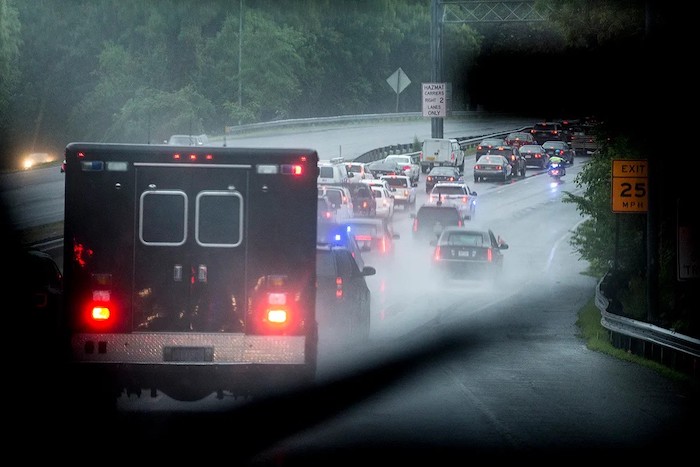
Support Vehicles usually transport high-value staff, such as parts of the President’s cabinet and their security detail, as well as additional security personnel and the President’s doctor.

The Control Vehicle carries a top military aid with the highest level of clearance, who would assist the Commander-in-Chief during a major military incident, giving operational guidance, and if need be, activating the Nuclear Football. These vehicles are usually modified SUVs, such as Chevrolet Suburbans with enhanced communications and low-profile police lighting, or rented vans.

ezgif-58a6c754c7e5e2.jpg

The Presidential Motorcade makes its way through traffic on a rain-soaked highway.Photo by AP

Counter Assault Team Vehicles: Nicknamed “Hawkeye Renegade”

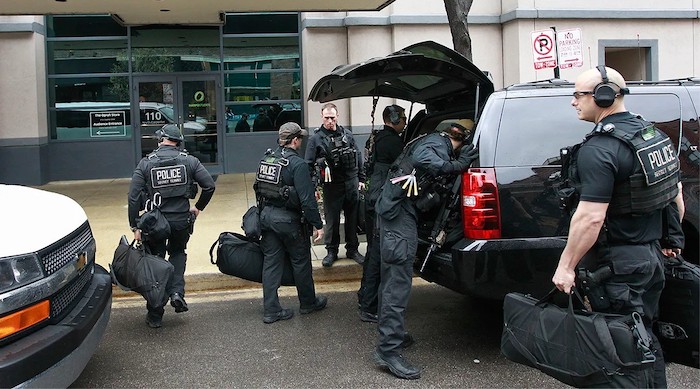
These vehicles are also usually black Suburbans or some other large SUV, with police lights, rails and running boards for external transport of agents, and they always have their rear gates ajar with a heavily armed and armored commando hanging out of the back, assault rifle at the ready.

The Secret Service’s Counter Assault Team, known as the ‘CAT,’ gives the Presidential Motorcade its heavy hitting combat punch. These elite Secret Service operators, selected from a tiny fraction of those who apply, carry state-of-the-art arms, including assault rifles, night vision goggles, expendables like flash bangs and concussion grenades, and sometimes heavy body armor.

ezgif-5a46b88ff8cb0d.jpg

The heavily-armed CAT riding in one of the motorcade’s Suburbans.Photo by AP

The CAT is the direct action unit that rapidly counter-attacks if the convoy is ambushed, or it sets up a defensive buffer if the convoy were about to be attacked. Meanwhile, the President’s Security Detail would work to rapidly evacuate the President from the scene.

Imagine an advancing, overwhelming, wall-like onslaught of suppressive fire and you get the picture of what these highly trained operators are all about. If they can’t vanquish a threat as it emerges or immediately extinguish an attack as it is initiated, they buy the President’s security detail time and space.

ezgif-58cc543099eb1b.jpg

The CAT on the move during a mission.Photo by AP

Intelligence Division Vehicle: The “ID Car”

This vehicle works as a ‘big picture’ intelligence node, communicating with over-watch and surveillance units, local police, and other intelligence sources about possible threats or obstacles along the motorcade’s route. The agents in this car try to identify problems before they occur.

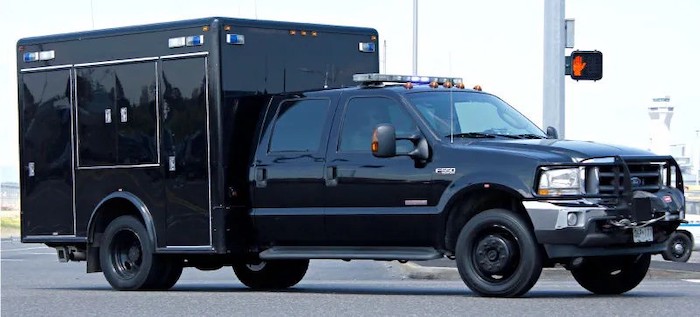
Hazard Materials Mitigation Unit

This black work truck carries sensors to detect, and gear to respond to, nuclear, biological or chemical (NBC) weapons attacks that threaten the Motorcade. It also works as a roving storage vehicle, carrying supplies and other classified capabilities.

ezgif-55b7cb459fd8c9.jpg

The HAZMAT Mitigation Unit on the roll.Photo by Paul Carter

Press Vans

These vehicles are usually large vans that carry the White House Press Corps in the motorcade. Obviously, this space is reserved for major news outlets and the White House media team. This includes a camera, wire and general press vans.

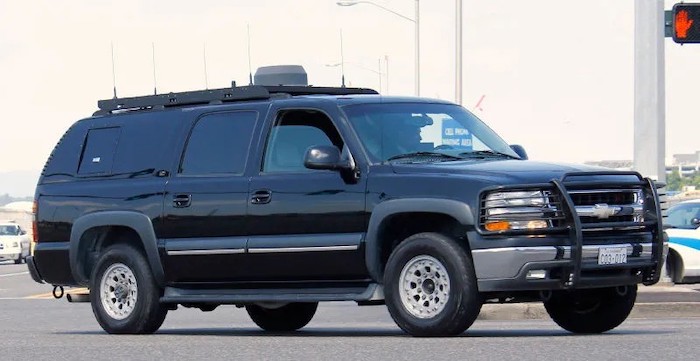
The White House Communications Agency Vehicle: Code Name “Roadrunner”

Roadrunner, also known as the Mobile Command and Control Vehicle, is one of the most conspicuous vehicles in Motorcade. A beefed-up Suburban, it houses a large satellite communications array and posts an antenna farm along its roof-line.

ezgif-55fbf1e43755d2.jpg

White House Communivation Agency vehicle code named Road Runner.Photo by Paul Carter

This vehicle keeps the President and White House officials securely connected to the world, providing encrypted voice, internet and video communications via the Pentagon’s constellation of hardened communications satellites. This vehicle may also be able to handle communications for nuclear arms release.

Roadrunner also helps facilitate secure communications within the Motorcade itself. Think of it as a big rolling data encryption center, wifi hotspot, radio repeater and doomsday communications control center.

Ambulance

An ambulance is a constant feature at the rear of the Presidential Motorcade. It is there to treat injuries that may occur following an attack, a wreck or an unexpected biological event. This resource is primarily reserved for the President.

ezgif-5bdf7da0ef96a5.jpg

An ambulance is always in tow. Photo by Paul Carter

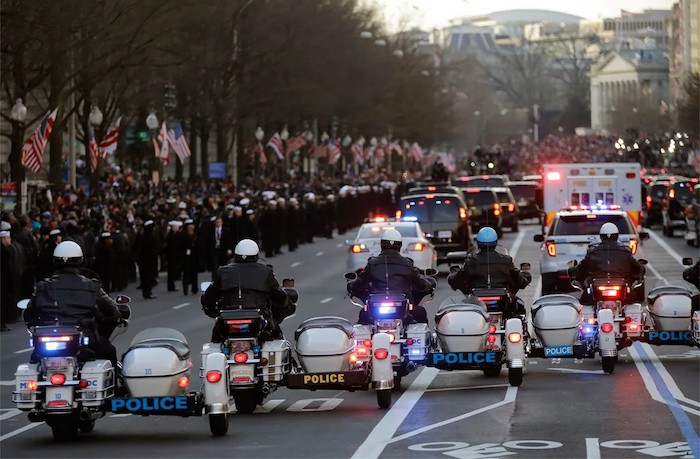
Rear Guard

This is usually a phalanx of local police vehicles, such as motorcycles and marked patrol cars. Their job is to provide early warning and a defensive buffer for the rear of the motorcade.

ezgif-51be7a24c97335.jpg

A brace of police motorcycle officers makes up the Rear Guard. Photo by AP

Overwatch

When the President travels, the Secret Service gets access to a Department of Homeland Security helicopter that provides intelligence, planning and over-watch for presidential movements. Depending on where the President is headed, this mission can be executed using a Coast Guard, Border Patrol, US Customs or other federal government chopper.

ezgif-5580ead691a4e9.jpg

A Secret Service agent peers out the side of a USCG MH-60T.Photo by Paul Carter

Ground Force One

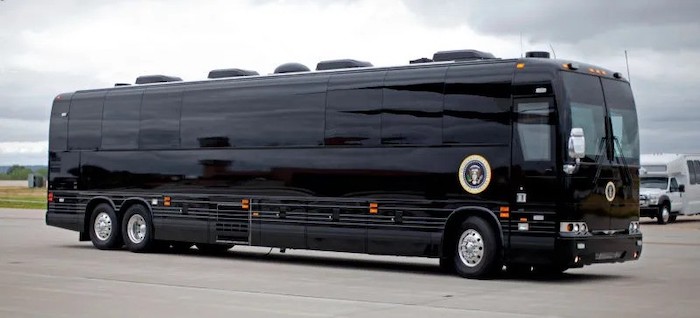
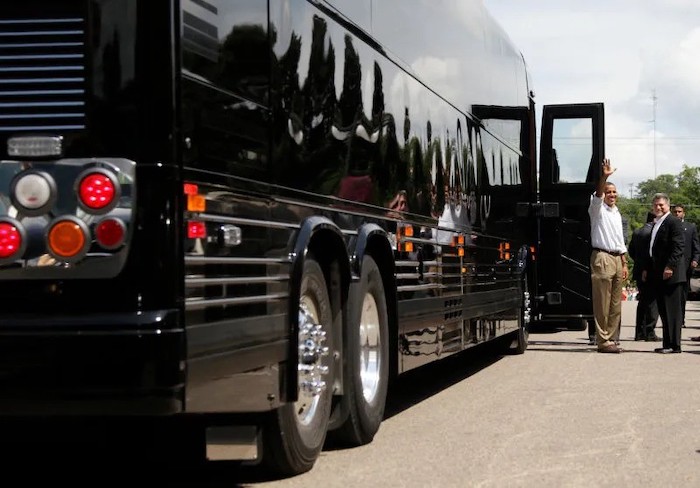
Although rarely deployed in Presidential travel, a pair of heavily modified and thickly armored buses were procured by the Secret Service around the turn of the decade. The joint project between Prevost Car and Hemphill Brothers Coach Company, known as the model X3-45 VIP 3, allows the President to travel more efficiently by road in rural areas when many stops are on the schedule.

ezgif-5a98a00d2fd603.jpg

The blacked-out Ground Force One sits at the ready.Photo by AP

Once delivered, these roving White Houses were painted gloss black and had advance communications installed to interconnect them with Roadrunner and the world beyond, as well as other improvements similar to what you would find in the Presidential limousine. Both limo buses were used leading up to the 2012 election, with President Obama using them to campaign across America’s heartland.

ezgif-518dbb327341c9.jpg

Obama waving from the entry of Ground Force One.Photo by AP

So there you have it: the real anatomy of the Presidential Motorcade. On a personal note, I have had the pleasure to see the whole motorcade, Air Force One, Marine One, Secret Service ballet multiple times with my own eyes. It is an absolutely amazing spectacle to watch.

The incredible focus and professionalism of everyone involved, and the way they balance time and risk, is mind boggling. When you think of the term ‘well-oiled machine,’ this is the picture that should pop into your head. There is an absolutely astonishing amount of moving parts that go into each and every Presidential movement.

ezgif-5dfebafe293d2a.jpg

The Presidential Motorcade touring Jordan’s historical sites.Photo by White House

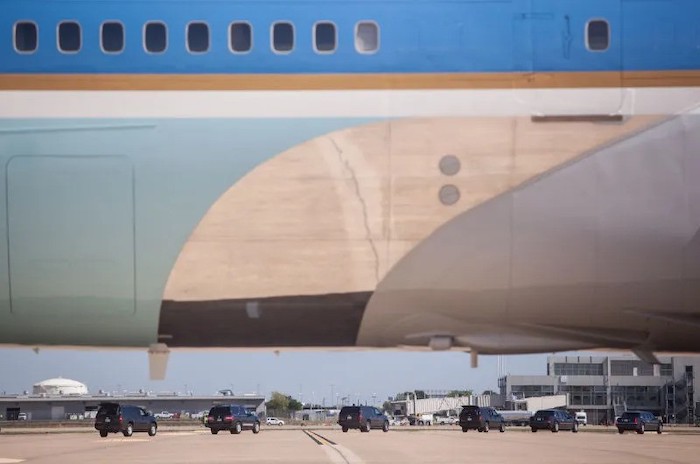
The times I’ve had the privilege to watch Air Force One’s arrival and departure, the motorcade moved into formation almost magically, zooming up to the President at the exact moment and speeding triumphantly across the tarmac in a wheel-like formation when he returned. Once stopped at the steps of Air Force One—just as its jet engines were spooling up—the President got out of his limousine, ran up the stairs and waved goodbye, the cabin door shutting after he entered. At that exact moment, the iconic 747 was rolling down the apron. Meanwhile the motorcade was ripping off back across the tarmac to prepare for transport. It is a single fluid and perfectly-timed set of movements.

I had never seen anything like it in my life and it plays far different in person than on television.

What I took away from these experiences, including observing the throngs of sharp shooters and heavily armed men and women staring at virtually everything behind tinted sunglasses, is this is not only a critical mission, but it is also an art form and a showcase of what we are capable of as a nation.

ezgif-53a3600bdbba0d.jpg

The Presidential Motorcade speeds across the tarmac after leaving Air Force One.Photo by AP

I have seen this in the military before—to varying degrees, and especially in top tier units, where it is not just about schedules or procedures, but also about nailing it exactly the same way every time and making it look easy. Of course, it’s anything but easy, and the Secret Service has to get it right every time.

All the technology that goes into protecting the President is amazing, and frankly, so is the price tag. But there is a reason why this incredible traveling show, perhaps the most expensive in the world, rarely makes news beyond the objective of the mission itself. That is because the people orchestrating it are absolutely the best at what they do and they go about their business knowing that the world is watching.

ezgif-5ce91eae103d55.jpg

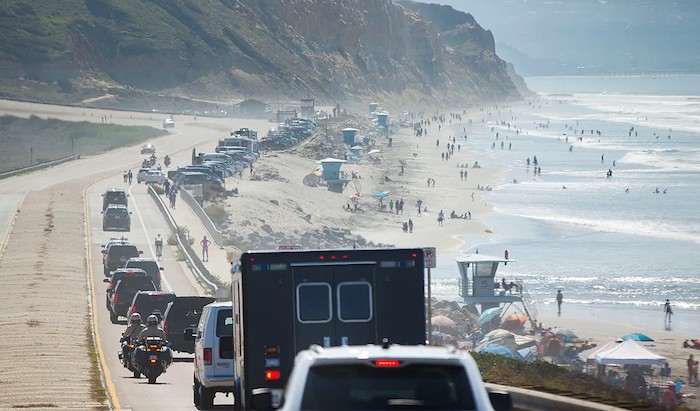
The Presidential Motorcade moves along Highway 101.Photo by AP

Sure there have been recent controversies, but the White House arm of the Secret Service is a national treasure. They have a mind blowingly difficult job and they deserve much more recognition than they will ever receive. The fact that the most powerful and targeted man on earth can drive around where he wants to go on a regular basis, and it all seems normal and uneventful, is just a reminder of that.

BIDEN’S ADMINISTRATION WASTED BILLIONS TO CRONIES FOR CLEAN ENERGY IN FINAL DAYS !

Despite Warnings, Biden’s Energy Department Disbursed $42 Billion In Its Final Hours

In its last two working days, the Biden administration’s Energy Department signed off on nearly $42 billion for green energy projects – a sum that exceeded the total amount its Loan Programs Office (LPO) had put out in the past decade.

The frenzied activity on Jan. 16 and 17, 2025, capped a spending binge that saw the LPO approve at least $93 billion in current and future disbursements after Vice President Kamala Harris lost the 2024 election in November, according to documents provided by the department to RealClearInvestigations. It appears that Biden officials were rushing to deploy billions in approved funding in anticipation that the incoming Trump administration would seek to redirect uncommitted money away from clean energy projects.

The agreements were made despite a warning from the department’s inspector general, urging the loan office to suspend operations in December over concerns that post-election loans could present conflicts of interest.

In just a few months, some of the deals have already become dicey, leading to fears that the Biden administration has created multiple Solyndras, the green energy company that went bankrupt after the Obama administration gave it $570 million. These deals include:

  • Sunnova, a rooftop solar outfit that thus far had $382 million of its $3.3 billion loan guaranteed, filed for bankruptcy this month. The company did not respond to a request for comment.
  • Li-Cycle, a battery recycling facility, had a $445 million loan approved in November, but since then, the company was put up for sale and has filed for bankruptcy. The Energy Department said no money has been disbursed on that deal. Li-Cycle did not respond to a request for comment.
  • A $705 million loan was approved on Jan. 17 for Zum Energy, an electric school bus company in California, and its “Project Marigold.” At $350,000 and more, electric school buses currently cost more than twice as much as their diesel counterparts. So far, Zum has received $21.7 million from the government, according to usaspending.gov. The company did not respond to a request for comment.
  • A $9.63 billion Blue Oval SK loan on Jan. 16 was the second largest post-election deal, topped only by a $15 billion loan the next day to Pacific Gas & Electric, with most of that for renewables. The Blue Oval project in Kentucky – a joint venture between Ford Motor Co. and a South Korean entity – has been dealing with numerous workplace complaints, and construction of a second EV battery manufacturing plant there has been delayed. More than $7 billion has been obligated on that deal, according to the Energy Department. Blue Oval did not respond to a request for comment.

The money and the hasty way in which it was earmarked have drawn the attention of the Trump administration. “It is extremely concerning how many dozens of billions of dollars were rushed out the door without proper due diligence in the final days of the Biden administration,” Energy Secretary Chris Wright said in a statement to RCI. “DOE is undertaking a thorough review of financial assistance that identifies waste of taxpayer dollars.”

The enormous sums came from the 2022 Inflation Reduction Act, which injected $400 billion into the LPO, a previously sleepy Energy Department branch originally intended to spur nuclear energy projects. That total represented more than 10 times the amount the LPO had ever committed in any fiscal year of its existence. Prior to the post-election blowout, the office’s biggest fiscal year was 2024, when it committed $34.8 billion, records show.

Even with the rush to push billions out the door in its last months, close to $300 billion of the Inflation Reduction Act money remains uncommitted by the LPO. Trump administration officials have already nixed some smaller deals. Secretary Wright recently urged Congress to keep the money in place as the LPO now aims to use it to further the Trump administration’s energy policy, particularly with nuclear projects.

That unprecedented gusher of cash from the LPO echoes the efforts of the Biden administration’s Environmental Protection Agency to push $20 billion out the door before it left office. As RCI has previously reported, the EPA – which had never been a consequential grant-making operation – was tasked with awarding $27 billion in Inflation Reduction Act funding through the Greenhouse Gas Reduction Fund and Solar For All programs. It did so in less than six months in 2024, including an unorthodox arrangement in which Biden officials parked some $20 billion outside the Treasury’s control. That money was earmarked for a handful of nonprofits, some of which had skimpy assets and were linked with politically connected directors.

The LPO’s post-election bonanza was put together in even less time. The Energy Department deals, however, involve mostly for-profit enterprises, which raises questions about whether the Biden administration was propping up companies that would not have survived in the private marketplace. Should any of the companies hit it big in the future, shareholders could get rich, while taxpayers will receive only the interest on the loan.

The loan office should not be in the virtual venture business,” said Mark Mills, executive director of the National Center on Energy Analytics. “But in a few cases, it could make sense to serve as a catalyst or backstop for viable and important projects from a national security or policy perspective.”

RCI spoke with several Trump administration officials who declined to comment on the record, given the extensive ongoing review of both the LPO’s post-election arrangements and other Energy Department projects linked to Biden’s climate agenda.

They wanted to get the billions to companies that probably wouldn’t exist unless they could get money from the government,” one current official said. “The business plans, such as they were, were ‘how do we secure capital from the government?’”

During Biden’s tenure, the office was run by Jigar Shah, who on June 17 was named to the board of directors of the nonprofit Center for Sustainable Energy. Bloomberg News reported last month that Shah “helped select roughly 400 companies with development plans to receive grants and loans upwards of $100 million each.” In response to the Trump administration’s pushback on green subsidies, Bloomberg reported that Shah is working to help some of the companies he bankrolled shift operations to Europe.

The Center relies chiefly on government contracts instead of donations, and it saw that revenue jump from $274.1 million in 2023 to more than $500 million in 2024, according to tax records. The center did not respond to a request to speak with Shah.

Thus far, no entity has received the entire amount of the deals the Biden administration struck since last November, according to the Energy Department and usaspending.gov. In a handful of cases, companies have come to the current administration and opted out of the deals.

Still, millions of taxpayer dollars have already been distributed, in some instances, to deals the department listed as “conditional commitments.”  Wright has said there are “reasons to be worried and suspicious” about the post-election binge, and vowed some of the deals will be scrubbed.

In 2023, the Biden administration made subtle changes to the LPO’s regulations, cutting strings and stipulations that traditionally attach to loans. Consequently, the office cut deals after the election on terms more favorable to the recipient than the taxpayer, and in several cases, making a “conditional commitment” the same as a loan, according to Trump officials. The changes also moved money that a later administration could have cut into “obligated” silos, making the deals harder to cancel, according to the current Energy Department.

Essentially, they had the Loan Program Office operating like a graveyard energy venture capital fund,” one Trump official told RCI. “This was all tied to the religious fervor for any green energy project in the prior administration, and the goal was not to get the government repaid but to advance the ‘green new deal.’”

The $93 billion under review represents a separate “green bank” from smaller Biden administration deals that the Energy Department has already canceled. Last month, the Government Accounting Office said the department was not on track to “issue loans and guarantees before billions of dollars of new funding expires.”

As part of the review, Wright issued policy guidelines in May that he said offer more protection to taxpayers. The department may now require significantly more information from loan recipients and applicants, such as “a project’s financial health, a project’s technological and engineering viability, market conditions, compliance with award terms and conditions and compliance with legal requirements, including those related to national security.”

The department declined to provide the terms of specific deals, again citing the ongoing review. Trump administration officials claim the business plans for many of these deals were threadbare, that term sheets were essentially tossed out, and the entire process could be described, in the words of a Biden EPA official in December, as “throwing gold bars” off the Titanic “as an insurance policy against Trump winning.”

Despite these dubious outcomes and the alleged removal of taxpayer protections that accompanied the deals, Trump administration officials said they remain committed to the LPO. The office has a valuable role to play in fulfilling energy policy goals, which include nuclear projects, strengthening the nation’s power grid, and limiting the U.S. reliance on Chinese supply chains for key minerals and elements.

“It’s as if you went away and the kids threw a rager in the house,” one official told RCI. “You may need some new furniture and the like, but it’s still a really nice home. The Office can be a critical resource for the manufacturing base of this country, and our goal is not to end the LPO but to improve it.”

The Trump administration could face some of the same financial issues if it rejiggers the LPO along lines that support its energy policy goals, particularly within the nuclear industry. Projects there have been marred by unprofitable plants and massive cost overruns and delays in construction, making federal loans to the section inherently risky.

Prominent voices – and investors –  like Bill Gates have also encouraged the government to back new sources of energy and minerals. Geothermal projects are one such field, and there appears to be bipartisan support in Washington for capital that will shore up U.S. energy independence. On Jan. 15, the Biden administration approved a $1.2 billion “conditional commitment” with a subsidiary of EnergySource Minerals LLC (ESM), which hopes to extract lithium from geothermal brine.

A deal with ioneer Ltd. appears to match some of the professed goals of the Trump administration, but it has also been plagued by financial setbacks since Biden’s LPO approved it in its final days. The company’s deal grew from an original $700 million “conditional commitment” in 2023, to the $996 million approved on Jan. 17, 2025.”

The Rhyolite Ridge project is a mining and manufacturing center in Nevada to produce lithium and boron. Those elements have implications for defense and national security in addition to energy, according to ioneer Vice President Chad Yeftich.

“Ioneer believes government policy should encourage projects if we want critical minerals developed domestically,” Yeftich said. “Time is the key risk for development as China continues to provide financial support to its critical minerals industry and dump critical minerals into the market thereby depressing the price.”

Yeftich noted Rhyolite Ridge has secured $200 million in private capital, but in February, its chief private equity partner broke ties with the project. Finance professionals familiar with big deals told RCI that such a rupture so close in timing to the loan would likely deep-six the arrangement, but Trump officials said Biden’s LPO stripped such boilerplate language from many of the post-election deals.

Secretary Wright told RCI that these maneuvers suggested the previous administration was more interested in disbursing funds than protecting taxpayers. “Any reputable business would have a process in place for evaluating spending and investments before money goes out the door, and the American people deserve no less from their federal government.”

LAVISH PALACES WHERE AUTHORITARIAN RULERS LIVE

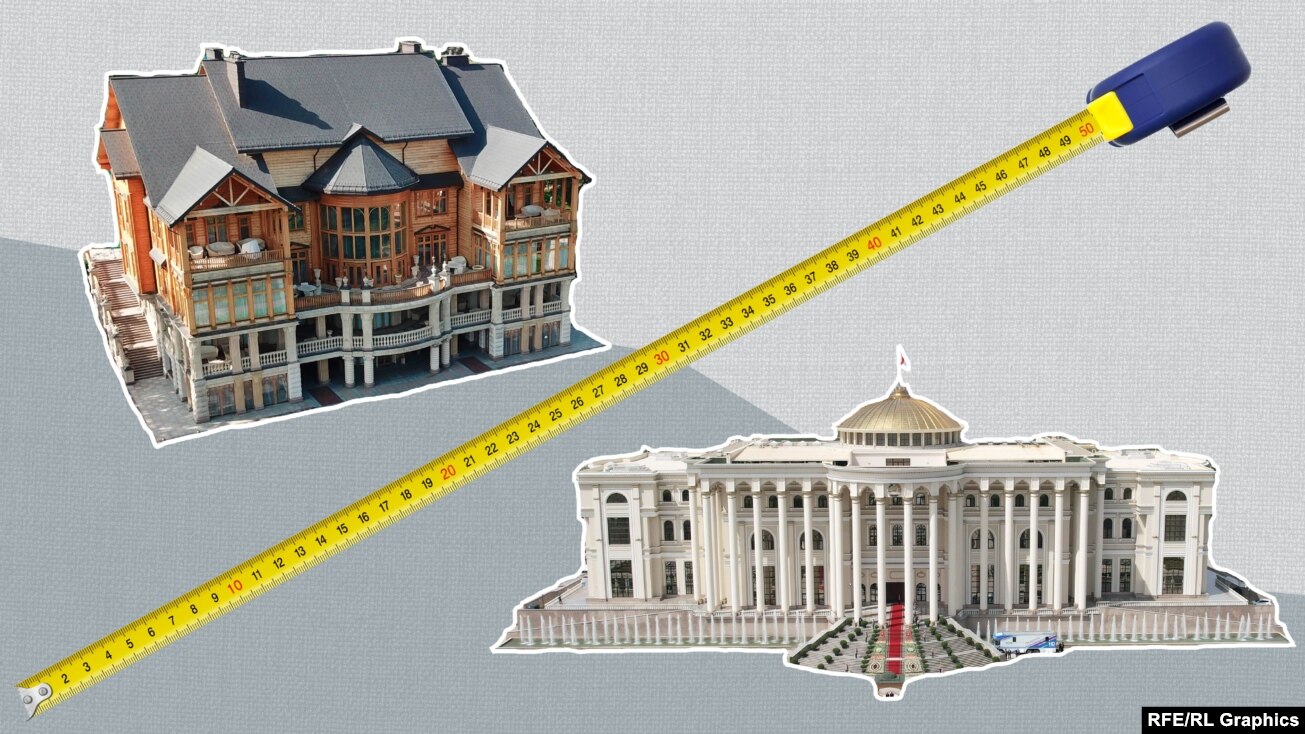
What do Ukraine’s Mezhyhirya Residence, Turkmenistan’s Oguzhan Palace, and Turkey’s Presidential Complex have in common? All were built at enormous expense, flaunting lavish amenities and sprawling grounds — monuments to the wealth and power of authoritarian rule.

Here’s a look at some of the world’s grandest presidential residences, where opulence meets political might.

UKRAINE, Novi Petrivtsi: Mezhyhirya Residence

Mezhyhirya was Viktor Yanukovych’s residence during his time as Ukraine’s prime minister and president until he fled amid the 2014 Maidan Revolution. Now a “museum of corruption,” it boasts a car museum, golf course, zoo, fountains, helicopter pad, and even a church — showcasing the former leader’s lavish lifestyle.

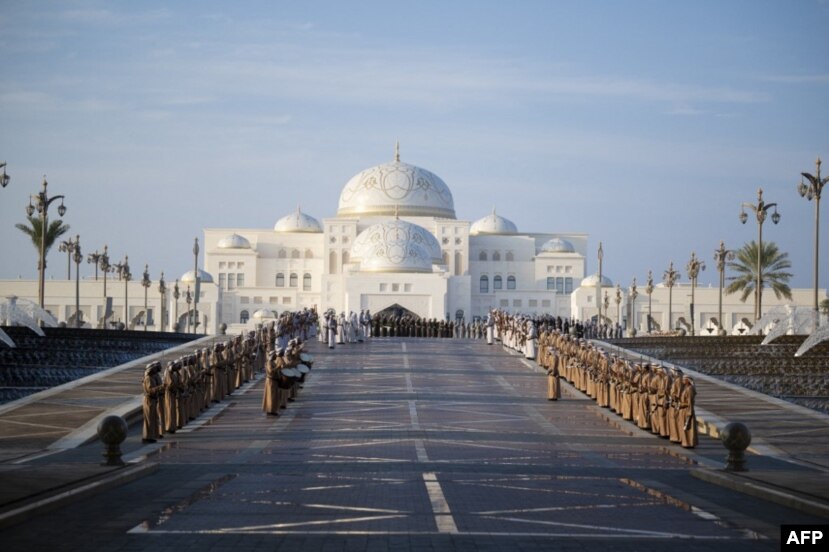
UNITED ARAB EMIRATES, Abu Dhabi: Qasr Al-Watan

Qasr Al-Watan, the presidential palace of the United Arab Emirates, was completed in 2017 and opened to the public in 2019. Built at a cost of $490 million, this predominantly white palace houses historical artifacts and manuscripts while also displaying diplomatic gifts received by the U.A.E.

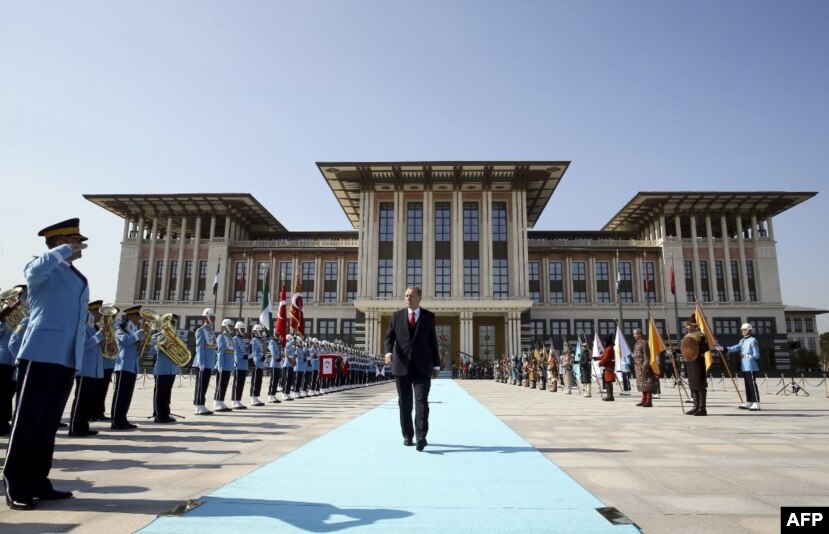
TURKEY, Ankara: Presidential Complex

The Presidential Palace in Ankara, also known as Ak Saray (White Palace), was completed in 2014 for Turkish President Recep Tayyip Erdogan. Built on former forest land, it boasts over 1,100 rooms and officially cost around $615 million, though critics say the true price was much higher. The complex includes a mosque with a capacity of around 3,000 and Turkey’s largest library, with a collection of more than 4 million books.

RUSSIA, Gelendzhik: ‘Putin’s Palace’

This palace complex on the Black Sea coast near Gelendzhik is rumored to be Vladimir Putin’s residence, with speculation about its existence dating back to 2010. In 2021, the late Russian opposition leader Aleksei Navalny released an investigative documentary claiming the palace was built for the Russian president at a cost of around $1.4 billion. According to the investigation, the complex features an underground hockey stadium, a theater, a vineyard, and a church. It also has a no-fly zone, and boats passing must give it a wide berth. Putin has denied ownership, while Russian oligarch Arkady Rotenberg claims the palace is his.

RUSSIA, Moscow Region: Novo-Ogaryovo

Novo-Ogaryovo is Vladimir Putin’s state residence located outside Moscow. Originally constructed in the 1950s, the estate underwent extensive renovations under Putin’s direction after 2000. According to some reports, areas have been added to the compound recently, including a recreational facility belonging to Russia’s Federal Protection Service (FSO), heliports, and even air-defense systems. There might also be a tunnel leading from the FSO facility to Putin’s residence.

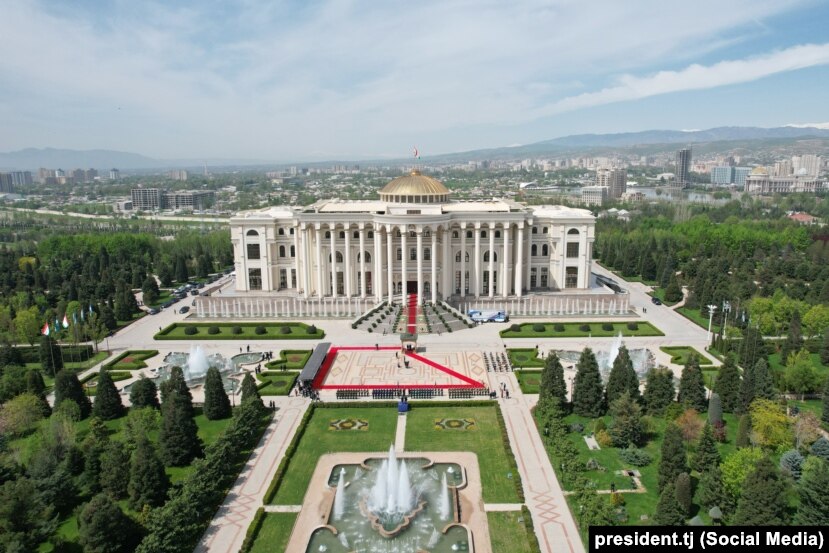
TAJIKISTAN, Dushanbe: Palace Of The Nation

The Palace of the Nation, completed in 2008, is the official residence of Tajik President Emomali Rahmon. To make space for the palace, a 100-year-old synagogue and other buildings in the neighborhood were controversially demolished. Built for $300 million, the palace is surrounded by parks, fountains, and other notable landmarks, including the Independence Monument and the Dushanbe Flagpole, which rises to a height of 165 meters and was once the tallest in the world.

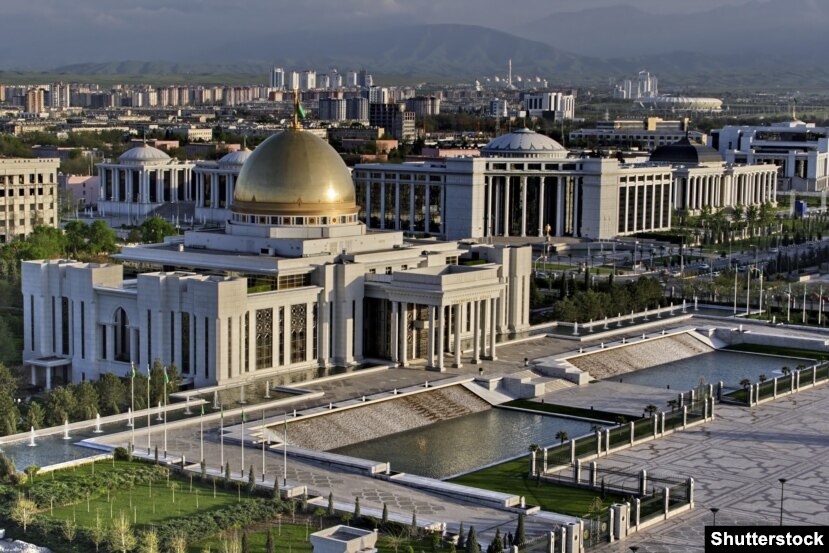
TURKMENISTAN, Ashgabat: Oguzhan Presidential Palace

The Oguzhan complex is the official residence and workplace of Turkmen President Serdar Berdymukhammedov. Named after an ancient Turkmen tribal leader, it has been home to the country’s presidents since the 1990s. In 2011, a new palace and additional facilities were added at a cost of approximately $350 million. A state reception house and a square for parades and other state events are currently under construction in front of the palace.

CHINA DELIVERED FAKE DRIVER LICENSES TO ALLOW MASS ILLEGAL VOTING FOR BIDEN IN 2020 ELECTION, FBI HID THIS INFORMATION, TIK TOK USER DATA USED TO CREATE FALSE ID’S

Patel, Bongino say prior FBI leaders hid evidence of Chinese interference in 2020 election

“Previous FBI leadership chose to play politics and withhold key information from the American people,” the bureau’s new top two leaders say.

FBI Director Kash Patel and Deputy Director Dan Bongino alleged Tuesday that the bureau’s prior leadership “chose to play politics” and hide evidence from the American people of a Chinese plot to hijack the 2020 U.S. election with fake mail-in ballots for Joe Biden.

The two FBI leaders’ statement came a week after Just the News reported Patel turned over to Congress earlier this month a long-hidden intelligence report raising concerns that China had mass-produced fake U.S. driver’s licenses to carry out a scheme to swing the 2020 election to Biden with fake mail-in ballots.

Patel located the evidence based on information that Senate Judiciary Committee Chairman Chuck Grassley, R-Iowa, got from whistleblowers and forwarded to the FBI, officials said.

Patel and Bongino said Tuesday they are committed to getting Grassley and the American public more evidence about the plot and the failure to fully investigate it.

“Based on our continued review and production of FBI documents related to the CCP’s plot to interfere in the 2020 U.S. Presidential election, previous FBI leadership chose to play politics and withhold key information from the American people – exposing the weaponization of law enforcement for political purposes during the height of the 2020 election season,” Patel and Bongino said in statement given to Just the News.

“Thanks to the great Oversight work of Chairman Grassley, the information the old FBI regime covered up will now be released to the public,” they added. “This FBI leadership team will continue keeping our promise of aggressive transparency and working around the clock to fix the underlying problems to restore the FBI to the trusted institution the American people deserve.”

The newly declassified intelligence reports from August 2020 weren’t corroborated or fully investigated and instead were recalled from intelligence agencies at about the time that then-FBI Director Chris Wray testified there were no known plots of foreign interference ahead of the 2020 election in which Biden defeated Donald Trump, officials told Just the News. 

When they were recalled, FBI officials asked fellow spy agencies to destroy their copies of the intelligence report, which included detailed information from a cooperating confidential human source.

“This report was recalled in order to re-interview the source. Recipients should destroy all copies of the original report and remove the original report from all computer holdings,” the recall notice obtained by Just the News stated.
The subject line of the FBI intelligence bulletin succinctly stated the potential nature of the alleged plot: “Chinese Government Production and Export of Fraudulent US Driver’s Licenses to Chinese Sympathizers in the United States, in Order to Create Tens of Thousands of Fraudulent Mail-in Votes for US Presidential Candidate Joe Biden, in late August 2020

That said, the FBI bulletin provided significantly detailed information for agencies to investigate as leads to make sure the U.S. election wasn’t being hijacked by a foreign power seeking to exploit a sudden explosion in mail-in voting during the COVID-19 pandemic that struck earlier in 2020.

“In late August 2020, the Chinese government had produced a large amount of fraudulent United States driver’s licenses  that were secretly exported to the United States,” the report reads “The fraudulent driver’s licenses would allow tens of thousands of Chinese students and immigrants sympathetic to the Chinese Communist Party to vote for U.S. presidential candidate Joe Biden despite not being eligible to vote in the United States.”

“China had collected private US user data from millions of TikTok accounts, to include name, ID and address, which would allow the Chinese government to use real US persons’ information to create the fraudulent driver’s license,” the report continues. “The fraudulent driver’s licenses were to include true ID  number and true address of US citizens, making them difficult to detect. China planned to use the fraudulent driver’s licenses to  account for tens of thousands of mail-in votes.”

THE FBI LIES, IS CORRUPT AND CREATED AN APP THAT HID INFORMATION !

Sen. Chuck Grassley’s release last week of an FBI memorandum discussing the Bureau’s ability to render computerized records invisible to other agents raises huge constitutional and corruption concerns. On Monday, The Federalist analyzed the revelations from that recently declassified document, explaining that material coded “Prohibited Access” in the FBI’s Sentinel case management system will not appear in search results, meaning that users of Sentinel would not know that information relevant to their search even exists.

If Sentinel users do not know that relevant evidence exists, the DOJ cannot possibly provide exculpatory or impeachment evidence to criminal defendants or fulfill their discovery obligations in civil cases. Nor could the DOJ and FBI find all responsive documents for Freedom of Information Act requests, or in response to congressional inquiries or investigations by the inspector general. And the FBI cannot possibly properly investigate criminality if its agents do not even know of potentially relevant evidence.

From the scant evidence available to date, we know that these concerns are not merely hypothetical. Documents related to the Trump/Russia-collusion investigation were coded “Prohibited Access.” That coding prevented agents in the Washington Field Office from identifying potentially relevant evidence concerning whether Fusion GPS contractor Nellie Ohr lied to Congress about her role in the Crossfire Hurricane hoax.

We also know that the U.S. attorney screening material related to Ukraine corruption and the Biden family did not know that the FBI could render material invisible in Sentinel. Likewise, senior DOJ officials familiar with the investigation into the Russia collusion hoax had no knowledge of the “Prohibited Access” functionality. Whether those investigations were similarly stymied is currently unknown because there is so little we presently understand about the FBI’s use of “Prohibited Access.”

Likewise, whether — and if so, how frequently — the DOJ violated its obligation to provide exculpatory and impeachment evidence to criminal defendants, or failed to meet discovery obligations, because of Sentinel’s “Prohibited Access” functionality, is a giant question mark. Whether files rendered invisible in Sentinel were likewise wrongfully withheld from Congress, the inspector general, or those submitting FOIA requests also remains unknown and will be until we get answers to some fundamental questions.

Here are the questions the FBI needs to answer:

When was the Prohibited Access function added to Sentinel? Who decided to add that functionality? Who approved that decision? And who was told of that decision?

Who could mark material Prohibited Access? What standard determines whether material is classified Prohibited Access versus Restricted Access? Who must approve the Prohibited Access designation? Who can see the existence of files designated Prohibited Access?

How long are materials maintained under the Prohibited Access designation? What happens if all the individuals with Prohibited Access to a file leave the Bureau? Can anyone see the existence of the file?

Are Prohibited Access materials ever deleted? Can Sentinel be audited to determine if documents have been deleted, and, if so, by whom? Can those documents be recovered?

Has an audit ever been conducted on Prohibited Access files? By whom? What were the results?

Can the FBI obtain a list of all Prohibited Access materials? How? Has the FBI obtained such a list? How many documents were logged as Prohibited Access? Has anyone reviewed those documents to ascertain whether they were relevant to any criminal or civil cases? Congressional or IG investigations? FOIA requests?

When someone searches for a term that appears in a Prohibited Access document and receives a message that indicates there are no responsive documents, does that trigger an alert to the agents working on the Prohibited Access case? If so, what steps are taken to ensure any relevant information hidden behind the Prohibited Access coding reaches the proper parties?

Do all FBI agents know about the Prohibited Access functionality? Is it in training material? Does the FBI’s Domestic Investigations Operations Guide cover Sentinel? Does Sentinel show the “Prohibited Access” coding as an option when entering a document? Have any agents expressed concerns over their inability to learn of the existence of relevant materials because of Prohibited Access?

When was the DOJ’s inspector general first alerted to the Prohibited Access functionality? By whom? What was the inspector general told?

What is the FBI’s procedure for searching Sentinel in response to requests from the DOJ for either criminal or civil cases? For FOIA cases? In response to congressional inquiries? In response to requests from the inspector general?

These are merely the general questions about Sentinel and the Prohibited Access functionality that need answering. How many more questions follow depends on the answers to these initial queries: If there were only a few cases or a few documents classified as Prohibited Access, the concerns will be much narrower. But if the FBI used Prohibited Access coding on a widespread basis, the ramifications will be enormous.

Jason Foster, the Founder and Chair of Empower Oversight, a  nonprofit, nonpartisan organization dedicated to combat waste, fraud, and abuse both inside and outside government, concurred with this assessment, telling The Federalist:

“Making a digital record unsearchable effectively deletes it for all other FBI users and creates the potential to taint thousands of FBI investigations, much like the 1990s FBI crime lab scandal did. That scandal sparked decades of consequences, even as late as 2015 when a DOJ review found errors in FBI hair analysis testimony in dozens of death penalty cases. The implications here for the government’s constitutional obligations to disclose evidence could be staggering.”

Foster, whose Empower Oversight organization represented the IRS whistleblowers who exposed the political interference in the Hunter Biden investigation, added that the Prohibited Access “feature sounds like it creates a digital black hole where evidence vanishes to all but the select few who already know it exists. This echoes J. Edgar Hoover’s secret ‘Official and Confidential files’ that were kept under the direct physical control of only himself and his personal secretary, who destroyed many of them after his death.”

But as Foster told The Federalist, the “new FBI leadership has an opportunity and an obligation to come clean.” “There needs to be a comprehensive review of how many records are essentially locked in this secret digital vault and who holds the keys,” Foster stressed.

Yes, and the FBI can start by answering the questions detailed above.

SAVE US FROM THE ERRORS OF THE CONGRESSIONAL BUDGET DINGBATS (CBO)

Save Us From the CBO

White House chief economist Kevin Hassett hit on a wider problem last week when he criticized the overly pessimistic prediction out of the Congressional Budget Office’s revenue estimating partner. The Joint Committee on Taxation said extending the 2017 tax cuts would cost some $4.6 trillion in government revenue over 10 years. Mr. Hassett pointed out that if the House reconciliation bill’s tax cuts could boost economic growth to 3%—still less than the post-World War II average— it would restore more than $4 trillion in income to Washington. In doing so, Mr. Hassett uncovered an issue that has swerved Washington into bad policy for decades.

The most powerful forces on Capitol Hill aren’t the House speaker and Senate majority leader, they’re the CBO and JCT. These two unelected bodies forecast how legislation could change spending and revenue over the next decade. Too often, these predictions are wildly off base.

In their defense, it isn’t an easy job. As Yogi Berra is supposed to have said: “Making predictions is hard to do, especially about the future.” What’s less defensible: The computer models that the CBO and JCT use for their predictions keep making the same mistakes.

The CBO and JCT routinely overestimate revenue from tax-rate increases as well as losses from tax cuts. The most recent example is the CBO estimate of the 2017 Trump tax cut’s fiscal effects. Its prediction has proved almost $1.5 trillion too low so far.

The explanation for this persistent error is that the CBO’s and JCT’s computer models fail to take adequate account of how tax-rate changes affect the amount and timing of businesses’ and workers’ decisions—including how much to save, invest and work. Higher tax rates also lead to more tax-avoidance strategies. Imagine how many decisions you would make differently if your income-tax rate rose from 20% to 50%.

Though the modelers now do some dynamic scoring, even this insufficiently accounts for the macroeconomic effects of lower taxes on growth.

Economists have decades of evidence that in most cases, U.S. tax-rate increases have lowered economic growth while tax-rate reductions have increased growth and employment. It happened after the tax cuts urged by Presidents Coolidge, Kennedy, Reagan and Trump. The CBO and JCT’s algorithms don’t adequately account for those historical data.

An infamous example of the JCT and CBO models’ spitting out crazy results came when Sen. Bob Packwood in 1988 requested that the JCT estimate how much revenue would be raised if Congress lifted the top tax rate on income above $200,000 to 100%. The answer to that is obviously close to zero. But the CBO calculated revenue increases of $104 billion the first year, $204 billion the second year, $232 billion in the third, and $299 billion in the fourth and fifth.

That gaffe is old, but the models are hardly better today. The CBO issued one of its most absurd revenue estimates to date this year on a bill sponsored by Senate Majority Leader John Thune to eliminate the federal gift and estate tax. The CBO told Congress it would cost the government more than $600 billion in lost revenue over the next decade. That’s hard to believe, given that the tax raised less than $34 billion in 2023, the latest year reported and the highest level of annual revenue from that tax this century. The CBO’s estimate entirely ignores studies that find that eliminating the estate tax would direct less money into estate-tax planning and avoidance and more money toward reinvestment in family-owned businesses and other ventures. Yet the CBO assumes virtually no benefit to the economy from eliminating this deleterious tax. A Ouija board could turn out more accurate prognostications.

Though these predictions so often fail, relying on terrible assumptions, Congress is still largely a slave to the CBO’s authority on the cost of a bill. The media brandish estimates from it and the JCT to frighten off legislators interested in growth-focused policy. Too often, it works. That’s no way to run a country.

GOVERNMENT AGENCIES WORKFORCE GENERALLY ARE DOING NOTHING, NOT WORKING AND HAVE SOME OF THE WEIRDEST HABITS, CHECK OUT THE PAINTED NAILS ON THIS PENTAGON FOUR STAR GENERAL

Federal Whistleblower Exposes DHS as a Woke Daycare: Coloring Books, Emotional Chaos, and Zero Enforcement

  • A DHS whistleblower reveals a workplace overrun by emotional instability, toxic relationships, and absurd distractions like coloring walls.
  • Federal employees admit to doing “nothing” for months, with no real work being conducted in critical agencies.
  • The Biden administration has turned law enforcement into a therapy session, eroding national security and institutional strength.
  • This culture of weakness is not accidental — it’s a deliberate strategy to keep Americans dependent and compliant.
  • Some of the greatest signs of weakness are coming from Republicans, who want to pass laws banning speech against Israel’s genocidal actions.

The collapse of American governance: From strength to coloring books

(Natural News)—Once, the U.S. government projected authority, discipline, and competence. Today, it’s a glorified daycare center where federal employees — supposedly tasked with national security — pass the time with coloring books and fake accomplishment certificates. A recent undercover interview with a Department of Homeland Security (DHS) employee confirms what many have long suspected: The federal bureaucracy is a hollow shell, staffed by emotionally fragile individuals more concerned with identity politics than enforcing the law.

“We have a coloring wall. Literally a coloring wall. Oh, coloring. Yeah, we have coloring books because we’re so bored, there’s nothing to do,” the whistleblower admitted. “We’ve been doing a bunch of training, and we’ve been giving each other fake Microsoft Word printout accomplishment letters of how amazing we are.”

This isn’t just incompetence — it’s institutional decay. The same government that once stood as a global superpower now employs agents who spend weeks performing meaningless tasks, questioning why they’re even there. “We were all doing basic security checks of individuals, which is just checking someone’s name and date of birth. And we were all doing this for a week, and we were wondering, why are we doing this?”
The rise of the weak: How emotional fragility replaced enforcement

The whistleblower’s most jarring revelation? The workplace culture is dominated by emotional instability and sexual identity politics. “I sit down at our first happy hour and I realize, holy s**, everybody’s gay. Everybody you work with? Everybody. Everybody’s a lesbian, gay, or in a toxic relationship.”*

This isn’t about personal lifestyle choices — it’s about the Left’s deliberate push to replace competence with identity-based groupthink. The federal government, once a symbol of American strength, now operates like a therapy session, where agents are rewarded for fragility rather than resilience.

This is the inevitable result of Diversity, Equity, and Inclusion (DEI) mandates, which prioritize feelings over function. When law enforcement agencies care more about pronouns than prosecuting crime, the nation is in deep trouble.

A government of children, for children

The Biden regime didn’t create this mess overnight, but it has accelerated the decline. The federal workforce is now a sanctuary for the emotionally stunted, where actual work is replaced with performative activism and self-congratulatory nonsense. The legacy of these spoiled children continues, even as reformers move into leadership positions to try and wrangle the woke mind virus, the group think, the DEI, the left-wing brainwashing, and the childish safe space coddling.

As much as we’d like to hope for a stronger, more unified government, one that stands on principle, even those reform figures we recently elected are kowtowing to speech controls that prioritize Israel’s genocidal actions. This is also a sign of cowardly group think among the Republican Party, and while many aren’t taking to coloring books to cope with the issues, they still look like children sitting around Netanyahu’s table, hoping to impress their daddy. Since Biden left office, there’s still warmongering and other forms of right wing group think that have permeated – showing that violent and cowardly tendencies have infected even the reformers that we cheered on to take over the dying left-wing government.

None of the federal government’s current bloviating is real governance — it’s a slow-motion collapse. A nation cannot survive when its institutions are run by people who need coloring books to cope with their jobs. The Left’s obsession with “safe spaces” has turned the U.S. government into a laughingstock, incapable of defending its own borders, enforcing its own laws, or maintaining basic order. The Right’s obsession with admiring itself, with violence in the Middle East and speech controls that protect Israel’s genocidal actions have made accountability and trust in government a laughingstock as well.

History shows that civilizations crumble when their leaders prioritize comfort over courage. Rome didn’t fall in a day — it rotted from within, its institutions weakened by decadence and distraction. The U.S. is following the same path, trading strength for sensitivity, law and order for appeasement.

As this whistleblower’s account proves, the federal government is no longer a serious entity. It’s a daycare for the emotionally dependent, a bureaucracy of broken minds. The question now is: When the real threats come — and they will — who will be left to stand against them? ICE Barbie, cosplaying with guns, outfits, and ten layers of makeup?

FAA THE DUMBEST EMPLOYER IN THE WORLD! BIDEN ERA HIRING POLICIES ARE THE DUMBEST !

President Trump pointed to hiring guidance for the Federal Aviation Authority which included positive preference for those with disabilities including “hearing, vision, missing extremities, partial paralysis, complete paralysis, epilepsy, severe intellectual disability, psychiatric disability and dwarfism.”

THE CRAZY DEI POLICIES HAVE NO PLACE IN THE WORLD OF AVIATION SAFETY!

Can you imagine an air traffic controller with severe intellectual disability or psychiatric disability guiding an airliner landing!????

THE DUMBEST PRESIDENT enacting the dumbest policies is finally off the stage!


MASSIVE VOTER FRAUD DISCOVERED IN WISCONSIN VOTER DATABASE, DUPLICATE FAKE VOTERS!

A Newly Discovered Algorithm in Wisconsin Voter File is Indisputable Evidence of Criminal Election Fraud

Andrew Paquette, Ph.D., has discovered a never-before-seen algorithm in the Wisconsin Election Commission’s (WEC) voter registration database, leaving no doubt someone has penetrated the WEC’s computer system to impose a criminal reordering on the voter files. This finding alone should draw the attention of Director of National Intelligence Tulsi Gabbard, Attorney General Pam Bondi, and FBI Director Kash Patel. Yet, to date, we see no action whatsoever from the DOJ or the FBI investigating criminal election fraud.

Paquette first observed that the WEC voter role had an unusually high number of voter records that ended in zero. Assuming that the WEC voter roll assigned voter ID numbers sequentially, without breaks or outside manipulation, records ending in 0, 1, 2, 3, 4, 5, 6, 7, 8, and 9 should appear with equal distribution. As seen in Table 1, voter records ending in zero occurred in 30.6 percent of the voter records, while those ending in numbers 1 through 9 ended with each number appearing equally at 7.7 percent of the time.

Paquette was at a loss to explain this irregularity until he realized that every voter ID record ending in zero had two different Wisconsin voters assigned the same voter ID number. In searching the database, Paquette confirmed that in every case where the same voter ID number was assigned to two different voters, the voter record ended in zero.

We have labeled the two voter IDs tied to WEC voter records ending in zero as “doubles,” a term devised to distinguish this phenomenon from the “modified duplicates” that Paquette previously found in the WEC voter database. “Modified duplicates” involve making multiple voter records for the same voter, which can be done, for instance, by assigning a different birthdate or address to each duplicated record. Because duplicated voters each have different dates of birth or other addresses, the “modified duplicates” appear to be different people.

The point of the “modified duplicate” scheme is to create false voters, all of whom nevertheless get legitimate state voter ID numbers. The non-existent “multiple duplicate” voters can then be hidden back in the voter role, identifiable to the criminals by “algorithm locator numbers,” so they are available for use in fraudulent mail-in ballot schemes.

Why the “doubles” scheme assigns the same voter ID number to two different voters is more difficult to figure out. What is also not clear is whether one or both of the “doubles” are real voters or if both of the “doubles” voters could be fictitious.

A scheme this complicated must operate through a computer algorithm that creates “doubles” for every voter ID record ending in zero in a WEC database of over 7 million voters. That is, whatever rule is applied to pick the two voters who constitute the “doubles” in a database with over 7 million voters needs an algorithm if the scheme is to be applied, monitored, and updated on an ongoing basis.

Put another way, this cannot be random. Because there’s numerical consistency when it comes to all zero-ending records involving doubles and all duplicate voters having only zero-ending voter IDs, that implies a set of programming instructions (i.e., an algorithm) telling the system to create these records in formulaic fashion.

The probability that a scheme this complicated, consistent, and massive could happen by chance is near zero. The only logical conclusion is that someone penetrated the WEC server to embed the rule that would consistently alter the entire WEC voter registration database.

The WEC “doubles” scheme violates the Help America Vote Act (HAVA, 2002), which requires that each voter have a unique voter ID number and that no coded information not readily perceptible to election workers may be embedded secretly in the state voter roll database. Given the HAVA mandate that each registered voter must have a unique voter ID number, there is no administrative necessity justifying the fact that, as it now stands, every record in the WEC voter database with a voter numbering ending in zero is associated with two distinct voters.

We have previously argued that President Trump has chosen to elevate the election fraud investigation into a national security matter by bypassing a DOJ criminal investigation with Director of National Intelligence Tulsi Gabbard at the helm. The Department of Homeland Security has exercised authority in Arizona to review Arizona’s state voter roll to verify the citizenship of voters under the authority of President Trump’s Executive Order.

On April 23, 2025, Tulsi Gabbard referred two members of the intelligence community for criminal prosecution by the DOJ for leaking classified information to the Washington Post and the New York Times. This was information about the U.S. military strike on Houthi rebels. The leak was intended to harm Secretary of Defense Pete Hegseth. Gabbard indicated that her action would “serve as a warning” to those “deep-state criminals” who “for partisan political purposes” sought “to undermine President Trump’s agenda.”

In that spirit, and in the absence of aggressive DOJ/FBI efforts to investigate deep-state criminals, Gabbard may have found a methodology that has a chance of spurring Bondi and Patel to action.

We now have abundant evidence that the WEC maintains a criminally infected voter registration database that was used in the 2024 general election and in the recent 2025 election for a seat on the Wisconsin State Supreme Court. Bondi needs to appoint a DOJ election integrity Task Force that will give Patel’s FBI sufficient subpoena power to seize WEC computers, voter registration files, and relevant internal documents, including emails. What’s holding Bondi and Patel back?

Andrew Paquette, Ph.D., has discovered cryptographic algorithms in the State Board of Elections voter registration databases in New York, Ohio, Pennsylvania, Georgia, Arizona, Florida, New Jersey, and Oklahoma.

439 GOVERNMENT AGENCIES CHARGE OVER $2 TRILLION IN HIDDEN TAXES, TIME TO D.O.D.G.E THEM ALL!

Average American Family Pays Thousands in Hidden Taxes, Making Case for DOGE Even Stronger

The government doesn’t just directly charge Americans in taxes—it also imposes a hidden tax that makes everything more expensive, according to a new report.

The federal government doesn’t just pass laws in Congress. Each year, many of the 438 federal agencies—nominally under the president’s control through the executive branch—publish tens of thousands of pages in regulations, red tape that increases the costs of business, transportation, and many other factors Americans often don’t consider.

This imposes a kind of hidden tax that makes everything more expensive. It also justifies the work of the Department of Government Efficiency and other efforts to streamline the federal government, according to Clyde Wayne Crews, a fellow at the Competitive Enterprise Institute and author of the annual report, “Ten Thousand Commandments.” Crews released the 2025 version of the report on Thursday.

The report “directly and indirectly makes the case that DOGE or a successor entity—but especially Congress itself through legislation—should be more aggressive on deregulation,” Crews told The Daily Signal on Thursday.

According to the report, federal regulation costs Americans at least $2.155 trillion every year—a cost of $16,016 annually per household. This sum constitutes 16% of the average household’s pre-tax income, and 21% of household expenses. Most American families spend less than that on health care, food, transportation, entertainment, apparel, services, and savings. Only the cost of housing, an average annual household expenditure of $25,436, exceeds the costs of regulation.

“Ordinary income and FICA taxes are itemized on pay stubs and calculated on tax returns,” the report notes. “Most regulatory costs are embedded in prices of goods and services, and never show up on a receipt or an annual statement.”

While the exact cost of these regulations that gets passed down to the consumer is impossible to gauge, the report provides a rough estimate that highlights the overall phenomenon.

The regulatory tax of $2.155 trillion comes close to the federal income tax, which collected $2.176 trillion in 2023, and stands at about four times the corporate income tax of $419 billion in 2023.

The report notes that the $2.155 trillion figure is likely an underestimate. The National Association of Manufacturers ran a similar analysis in October 2023, concluding that regulatory compliance costs the economy $3.079 trillion each year.

Crews emphasized to The Daily Signal the “fusion of federal spending and federal regulation over recent years.”

“Since COVID-19, we’ve had the CARES Act, the CHIPS and Science Act, the Inflation Reduction Act, the infrastructure law, and more, and these are all hyper-regulatory before bureaucrats even start writing rules,” Crews added.

While the Constitution places the authority to make laws in the hands of Congress, federal agencies issue far more regulations than Congress passes laws. During 2024, for example, agencies issued 3,248 final rules, compared with Congress passing 175 bills. That means for every one law passed by Congress and signed by the president, unelected bureaucrats finalized 19 regulations.

My book, “The Woketopus: The Dark Money Cabal Manipulating the Federal Government,” exposes the leftist groups that staffed and advised the Biden administration, using this bureaucracy to force their ideology on the American people.

The Federal Register, the list of all rules promulgated by the administrative state, closed at 106,109 pages in President Joe Biden’s last full year, the highest tally on record and a 19% increase over 2023. Former President Barack Obama’s final calendar year saw 95,894 pages (the highest page count for federal regulations in U.S. history), while the administrative state only managed to publish 61,067 pages in 2017, the first calendar year of the Trump administration.

The gargantuan impact of the administrative state highlights the necessity of DOGE, according to the author’s report. Yet Crews also noted that DOGE has a sunset date—July 4, 2026.

“Note that DOGE goes away in a year, so there needs to be an infrastructure built that maintains the regulatory streamlining along with the slashing of spending,” he told The Daily Signal. “To me, real regulatory reform has to start with termination of departments and agencies.”

President Donald Trump has been terminating some agencies and departments—by directing that the U.S. Agency for International Development merge back into the State Department and by directing the ultimate closure of the Department of Education.

These changes save Americans money directly—with USAID grants terminated—but as the Trump administration decreases the size and scope of the federal government, that may also save American households money in decreased regulatory burdens.

IT IS TIME TO SUNSET THESE AGENCIES OR HAVE AN ANNUAL REVIEW, AND GIVE TAXPAYERS THEIR MONEY BACK TO SPEND ON THE JOYS OF LIFE.