Category Archives: Humanoid Robots

CHINA’S HUMANOID WORKFORCE IS GOING TO OVERTAKE EVERYTHING HUMANS DO!!!!

Donald Trump has banned Chinese robots from being imported into the US – Xiao Benxiang/VCG via Getty Images

Unitree, China’s top robotics company, mesmerised the world earlier this year with its concert-hall display of humanoid robots doing martial arts.

As they flipped and kicked, a sci-fi future seemed suddenly present, wiping away the familiar old world of stumbling, fumbling mechanoids.

But Unitree has already moved on. In the company’s latest videos, a prototype robot is shown performing tasks that are easier than martial arts for humans, but far more difficult for robots.

UnifoLM-OminiA-0.3, nicknamed “Benben”, responds to voice commands. It picks up dirty laundry. It opens a bedside drawer and pulls out the correct box of pills.

Unitree, and China in general, are fast-forwarding to a future in which humanoid robots don’t just work in factories or warehouses. Instead they will also work in shops, cafes, hospitals, nursing homes, and even in people’s houses.

For the Chinese, this fixes the problems of a labour shortage and an ageing society. It puts menial work in the hands of sleepless machines that don’t mind it, and that will never claim sick leave or unemployment benefits.

That might seem harmless, or even beneficial. But not to Donald Trump.

When he, and many other US politicians, look at Benben, they see a different future: an army of imported Chinese robots in every American hospital, police station and home, ready at the flick of a switch to become hostile spies or even soldiers.

“The Chinese Communist Party is the biggest threat we face … We cannot allow these robots to become predominant in our country,” John Moolenaar, a Republican congressman, said this week.

With support from the Democrats, he has drafted a new law that would force the Pentagon to look at banning Chinese robots. But Trump hasn’t waited for Congress to finish debating it.

The Federal Communications Commission announced a ban on imported robots on Wednesday. It said the robots “collect data that could be leveraged by malign actors to surveil Americans, enhance the capabilities of foreign intelligence services, or to remotely commandeer the robots”.

The ban opens a new front in the US-China struggle for tech supremacy, with the two sides already sparring over magnets, semiconductors and AI.

A Unitree robot on the floor of the New York Stock Exchange last year. They are now banned from the US – Michael Nagle/Bloomberg

The Chinese foreign ministry reacted with outrage. It accused Washington of a “hegemonic mindset” and threatened to retaliate with “all necessary measures”.

But the Global Times newspaper, a Communist Party mouthpiece, was more condescending. Its post on X simply said: “If you can’t beat them, ban them.”

Can the US beat China? It is certainly no straggler in humanoid robotics.

America still leads the race in AI tech, without which any robot lacks a brain and will be a non-starter. And Elon Musk is hell-bent on starting production of Tesla’s Optimus robot later this year.

But China is way out in front: its legion of start-ups churned out 16,000 humanoid robots last year.

Officials said earlier this month that China is on track to produce 100,000 next year – enough to populate a mid-sized English town.

Wang Xingxing, the boss of Unitree, told Time magazine this month that Chinese humanoid robotics was anything from two to 10 years away from a “ChatGPT moment”.

“Once the technology surpasses this … inflection point, robots can gradually be rolled out for large-scale commercial use,” he said.

Globally, Bank of America has forecast that 10 million humanoid robots could be cohabiting the planet with us by 2035 – a population the size of Switzerland – soaring to three billion by 2060.

At that point, humanoid robots would replace one fifth of industrial workers, and half the workforce in the services sector.

Beijing can hardly wait. Its population could shrink by 60 million in the next decade – the equivalent of losing the whole of France – and the Chinese are ageing fast.

With no desire to pursue a policy of mass immigration, Beijing needs humanoid robots not just to replace missing workers in factories, but also to service a greying population.

This Chinese robot can direct traffic, detect violations and give verbal reminders – VCG

The decades of the one-child policy mean many older people, who already make up a quarter of the population, have little family support. Their care will have to come from the state and the market.

Companies are frantically trying to speed up the evolution of humanoid robots towards an electronic homo sapiens: one that can service complex needs and make reasoned decisions, rather than just stack boxes.

Unitree’s robots still look, well, robotic.

But Shenzhen-based UBtech is already experimenting with silicon skin and responsive facial expressions, which would better suit nursing homes or hotel reception desks.

This crosses what Masahiro Mori, the Japanese robotics guru, once called the “uncanny valley”.

Mori observed that we humans tend to warm to robots as long as they look like the ones we’ve seen dancing on stage this year.

But once they look more and more like us, we get a bit creeped out by them, and we might push back.

Chinese robots are becoming more and more lifelike – VCG

Beijing is betting that the Chinese will happily ride through the uncanny valley. It has allocated 1tn yuan (£110bn) to funding robotics, hoping to spur local governments and entrepreneurs to jump on the opportunity.

This was the template that built China’s world-beating electric-vehicle (EV) industry.

There are now about 150 companies focused on humanoids, with a much larger hinterland of industrial robot makers behind that.

EV makers are also expected to join the rush, with XPeng, an electric car company, the first to move. More patents for humanoid robot technology are being filed in China than in the rest of the world put together.

Nobody expects all these start-ups to survive. Some may end up as specialists, or will focus on smaller slices of the supply chain.

But the largest of them are already inking deals with industrial and tech companies in the US and Europe. About 90pc of the humanoid robots sold worldwide last year were Chinese-made.

“European firms could easily find themselves facing a repeat of the race for EVs, outpaced by China’s blend of industrial capacity and state support,” the Berlin-based think tank Merics warned this month.

“As the sector evolves, Chinese firms may also find solutions to the high-end components they currently rely on Western and Japanese firms to provide.”

China may be ahead in the race, but the starter’s gun has only just gone off. There are daunting technical hurdles to training and perfecting robots that can deal both adequately and safely with the unpredictable vagaries of the human world.

Clearing those obstacles will depend on AI, where the US is still in front. China’s advantages are scale, subsidies, and a huge industrial base.

“China has almost every element of the robotics supply chain, and can put all them together much quicker and at cheaper, lower cost,” says Pavlo Zvenyhorodskyi, of the Carnegie Endowment for International Peace.

The US ban will be a setback. Unitree, ahead of a partial float in Shanghai next month, told would-be investors that sales in America, which are now at risk, represent up to one-fifth of its revenue.

But Zvenyhorodskyi believes China still has the momentum. “With the pace and the trajectory that China is moving at, it’s very likely that in several years the gap with the US, Europe and Japan will be much smaller. Or China will in fact overtake them.”

From Star Wars and Blade Runner to Terminator and Robocop, the US has long led the world in telling stories about the world’s robotic future.

But it is only just waking up to the newer, and truer challenge: to lead the world in turning all that sci-fi into reality.

HUMANOID ROBOTS PERFORM FIRST EVER SURGERY!

Teleoperated humanoid robots complete first-ever live surgery

Surgeons controlled the movements of the robots remotely to perform the procedures
UC San Diego

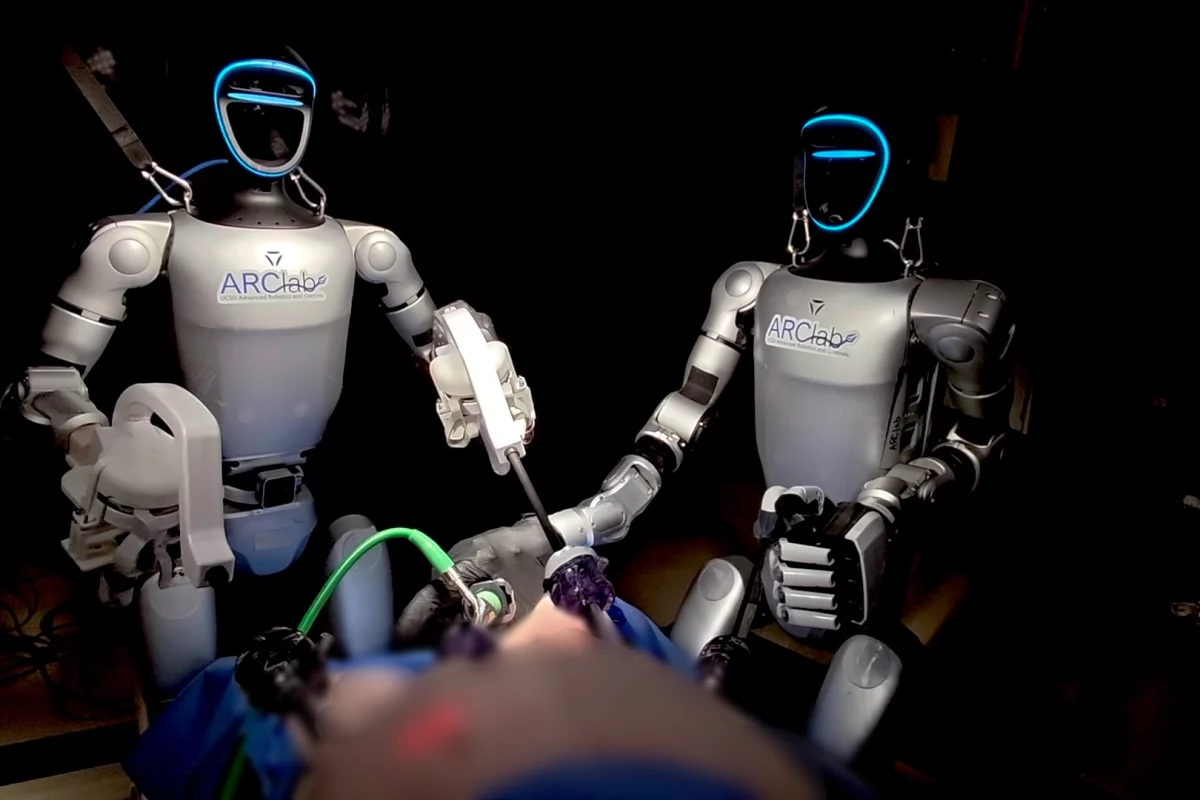
Surgeons at UC San Diego just handed the scalpel to two humanoid robots, who went on to complete live surgical procedures for the first time in history. This milestone moves beyond the fixed robotic arms found in operating rooms today and hints at an operating room of the future where humans and humanoids work side by side.

Humanoid robots are already showing up in factories, warehouses, and even on battlefields, precisely because their human-like shape lets them operate in spaces built for people without any redesign. A Morgan Stanley report from late June projects that China, the current leader in the field, will produce 446,000 humanoid units annually by 2030, with full-size humanoids growing from 30% market share in 2026 to 70% by 2028.

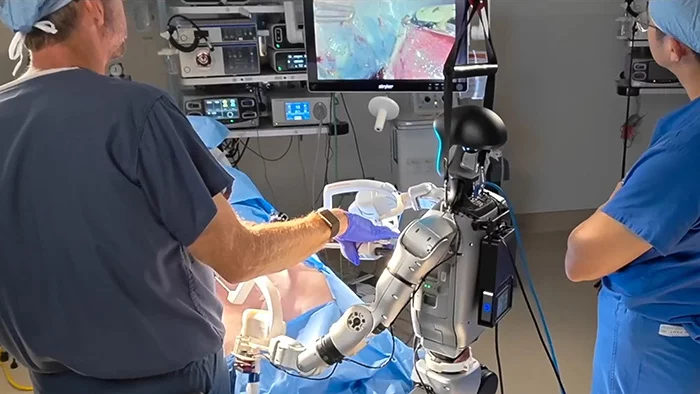
UC San Diego’s team wants to bring that same flexibility into the operating room. In one procedure, a humanoid robot and a human surgeon acting as an assistant completed a cholecystectomy (gallbladder removal). In a second, two humanoid robots worked together and finished the operation solo.

In one surgery, a humanoid robot and a human surgeon acting as an assistant successfully performed a gallbladder removal
UC San Diego

The trials, described in a paper published in Nature, were carried out on large non-primate mammals, but the achievement matters because it moves the technology from concept to something that has demonstrably handled real surgical tasks.

The researchers say their real target is the growing shortage of surgeons and the surgical backlogs it creates, especially in rural areas or regions far from major hospitals. Traditional surgical robots address none of that: they’re bulky, expensive, and typically require rebuilding the operating room around them.

A conventional robotic system weighs around 800 kg (1,764 lb) and needs significant space. The humanoid system used here, nicknamed Surgie, looks to have started life as a Unitree G1, and stands just 1.5 m (about 5 ft) tall and weighs only 27 kg (60 lb) – compact enough to wheel into a small clinic or a field hospital.

“It’s a fraction of the cost, and it takes a fraction of the space in an operating room,” says Dr. Shanglei Liu, assistant professor of surgery at UC San Diego School of Medicine and one of the study’s lead authors, who personally operated one of the robots during the trials. “So it’s easy to deploy, anywhere from rural areas to the battlefield and even to space.”

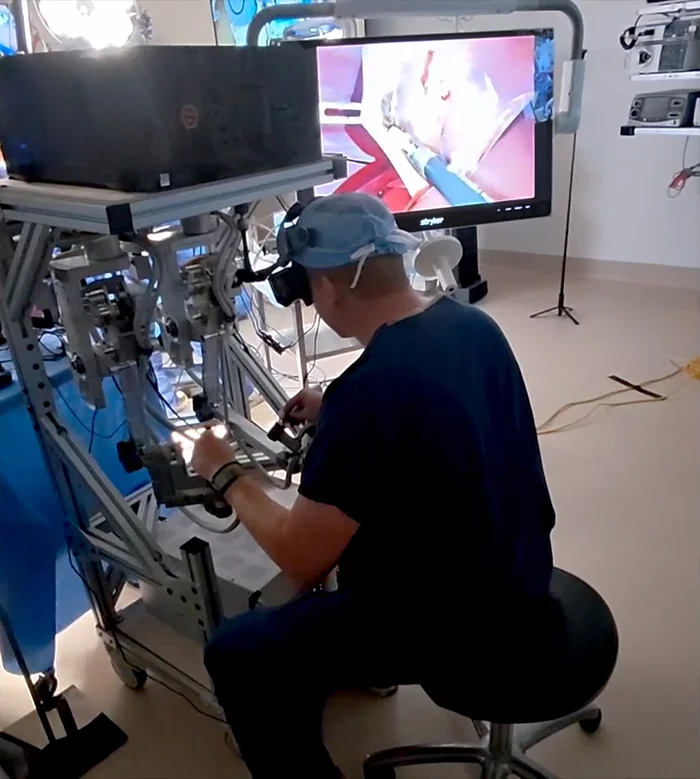
Dr. Ryan Broderick controls a robot during a gallbladder removal procedure
UC San Diego

The surgeons control the robots remotely, using standard surgical tools fitted with adapters so the robotic hands can grip and maneuver them properly. Testing moved through stages: lab simulations, animal trials, and finally live surgery. The results are promising but not flawless – the robots needed recalibration mid-procedure, operations took longer than usual, and latency (the lag between a surgeon’s hand movement and the robot’s response) remains a challenge for any remote-controlled surgery.

That said, today’s routine surgical robots also started out slow and clumsy. “This achievement reflects the power of bringing engineers and surgeon innovators together to solve meaningful clinical problems at our world-class training and research lab,” says Dr. Ryan Broderick, interim director of UC San Diego’s Center for the Future of Surgery.

The team envisions humanoids eventually doing more than assisting in surgery: fetching instruments, tidying the room, or working alongside human staff as full team members.

“Many communities struggle with adequate staffing on the surgical team, which means patients are not being treated,” says Dr. Michael Yip, a UC San Diego engineering professor and co-author. “Our goal is an operating theater of the future, where humanoid robots and humans work side by side as an integrated team to deliver procedures to those in need, both in traditional hospital settings as well as in non-traditional, field medicine scenarios.”