Welcome to Sterling Cooper, Inc.
  • CALL US: +1-866-285-6572
  • CALL US: +1-866-285-6572
LOGO
  • INCREASE YOUR REVENUES
    50%-100% - FREE EVALUATION
  • WEF 2025 GLOBAL
    RISKS REPORT
  • CAPITAL GAINS
    TAX DEFERRED
  • INCORPORATE
    NOW FOR $39
  • RESEARCH
    REPORTS
  • ENGULF &
    DEVOUR
  • Home
  • Services
    • Selling a Business
    • Buying a Business
    • Public Relation
    • Cooper consulting
    • Advertising
    • Publishing
    • Web and IT Services
    • Loans
  • Seller
  • buyer
  • Advertising
  • Publishing
  • M&A Due Diligence
  • Blog
  • Contact
LOGO

Category Archives: TRUMP

PRESIDENT TRUMP RELEASES HIS 2025 INCOME!!!

Trump’s annual financial disclosure shows more than $580M in crypto-related income

Key Points
  • President Donald Trump’s annual financial disclosure report was released by the U.S. Office of Government Ethics.
  • Trump’s crypto-related income included about $515 million from the sale of tokens released by World Liberty Financial, and $65 million from sales of equity in WLF’s holding company.
  • Trump disclosed he received $635 million in royalties from “Celebration Coins.”
  • The president reported more than $290 million in income from golf and club properties.
  • The ethics office also released Vice President JD Vance’s annual disclosure, which totaled 17 pages, compared to 927 pages for Trump.
President Trump raked in at least $2 billion in 2025

President Donald Trump’s annual financial disclosure report was released on Tuesday by the U.S. Office of Government Ethics, revealing income of hundreds of millions of dollars from proceeds of crypto tokens and holdings of hundreds of individual company stocks.

Trump’s disclosure report for 2025, which was the first year of his second non-consecutive term in the White House, totals 927 pages.

The report reveals that Trump’s crypto-related income included about $515 million from the sale of tokens released by the firm World Liberty Financial, and $65 million from sales of equity in WLF’s holding company.

WLF is the Trump-linked crypto company co-founded by members of his family that issues the WLFI governance token and USD1 stablecoin.

Trump, who first made his name in business with real estate developments in New York, also disclosed that he received $635 million in royalties from what were described as “Celebration Coins.” It was not immediately clear what those coins are. The Bloomberg news service reported that the royalties were related to CIC Digital LLC, Trump’s memecoin business.

Trump’s golf and club properties continued to generate major revenue, according to the disclosure.

The president reported more than $290 million in income related to revenue from his Mar-a-Lago Club in Palm Beach, Florida, his Trump National Doral golf property, his club in Bedminster, New Jersey, his Jupiter Golf Club and Trump National Washington, D.C.

One of the largest bursts of stock buying by Trump detailed in the disclosure occurred on Aug. 18, 2025.

The document shows three successive purchases of some of the biggest names in technology — Apple, Microsoft, and Nvidia — with each trade valued at between $5 million and $25 million. The values of Trump’s holdings are given in dollar ranges, not in absolute amounts, as is normal for U.S. government ethics filings.

The trades were among the largest individual stock transactions in the disclosure.

The Nvidia purchase came exactly one week after Trump announced that Nvidia and AMD had agreed to give the U.S. government 15% of their H20 chip sales to China in exchange for export approval. That deal reopened a key China revenue stream for Nvidia.

Apple also announced an additional $100 billion in U.S. investment on Aug. 6, bringing its total planned U.S. commitment to $600 billion.

The filing also shows that Trump purchased Amazon stock worth between $500,000 and $1 million on Sept. 23. That was the same day a trial began in Seattle federal court for a lawsuit by the Federal Trade Commission, which alleged Amazon duped customers into paying for Prime memberships.

The trial ended two days later after Amazon agreed to settle the suit by paying a $1 billion civil penalty to the FTC and refunds totaling $1.5 billion to an estimated 35 million customers.

Trump also reported receiving a total of more than $86 million in settlements of legal disputes from media companies including ABC, CBS, Meta, YouTube and X.

The massive filing is peppered with eye-opening assets, some of which are highly valued.

One line, on page 157, discloses an investment in gold bars valued at between $500,000 and $1 million.

Trump also disclosed receiving gifts totaling more than $370,000, primarily tickets to sports events.

They included 10 tickets to the FIFA men’s World Cup worth $15,000 from FIFA President Gianni Infantino, 10 Super Bowl LIX tickets from New Orleans Saints owner Gayle Benson, 15 tickets each to two UFC events from UFC CEO Dana White as well as tickets to other NFL, MLB, NCAA and golf events.

He disclosed that a statue from Sticker Mule CEO Anthony Constantino depicting Trump with his fist raised after an assassination attempt in Butler, Pennsylvania, was worth $250,000.

The disclosure also reveals a bevy of royalty deals that paint a picture of just how exhaustively Trump has been able to capitalize on his name and political brand since entering political life.

The royalty income includes: $4.7 million received through a licensing agreement for “Trump Watches” with The Best Watches on Earth LLC; a deal related to the publication of “The Greenwood Bible,” a collaboration with “God Bless the USA” singer Lee Greenwood, netting $208,486; a licensing deal for “Trump Sneakers & Fragrances” for $67,634; an endorsement of a ”’45′ Guitar” for $35,920; and publishing agreements for “Letters to Trump,” “Save America” and “A MAGA Journey,” for $590,730, $1,893,965 and $552,685, respectively.

Another line item shows Trump received a $200,000 speaking fee for a fundraising event in Naples, Florida, in December 2022.

The disclosure says the income from the watches and the sneakers-and-fragrances deal was “inadvertently omitted from” Trump’s prior financial disclosure, as was the balance he was owed from the 2022 speaking event.

The president’s disclosed liabilities included civil trial verdict judgments in favor of the writer E. Jean Carroll, who had accused Trump of sexually assaulting her in a New York City department store in the mid-1990s, and of defaming her after she went public with those allegations in 2019. The Supreme Court on Monday refused to hear Trump’s appeal of a jury verdict awarding Carroll $5 million for sexually abusing and defaming her.

Trump is still appealing another jury’s verdict, which awarded Carroll $83.3 million in that case for defamation. Trump denies sexually assaulting Carroll.

The disclosure also includes asset and income information for first lady Melania Trump — including $10.7 million in net proceeds through a license agreement related to her self-titled documentary film, “Melania.”

A separate license agreement with the film’s publisher, Skyhorse, netted her an additional $521,161 in income.

Melania Trump also reported $6,011,259 in income from a separate license agreement “for the sale of NFTs and other collectibles,” the form shows.

Trump’s annual disclosure was filed after he received a 45-day extension and does not appear to have triggered a late fee for the annual report itself.

But the filing says he paid late filing fees for transactions that had not previously been reported on required periodic transaction reports. The disclosure does not specify the total amount paid. The Office of Government Ethics’ standard late filing fee is $200.

The ethics office also released the annual financial disclosure report of Vice President JD Vance on Tuesday.

Vance’s report is a mere 17 pages.

The vice president’s report details earnings from his book, the firm Narya Capital, which he founded, the Rise of the Rest Seed Fund, where he had served as managing partner, and bitcoin holdings valued at between $250,000 and $500,000.

This entry was posted in TRUMP on July 13, 2026 by sterlingcooper.

PRESIDENT TRUMP MAKES $2.2 BILLION…

How President’s Personal Income Surged Last Year

President Trump’s personal income surged to more than $2.2 billion in the first year of his second term.

Unlike other presidents who generally have divested themselves of holdings or established blind trusts, Trump put many of his assets into a revocable trust overseen by Donald Trump Jr., who also co-heads the real-estate and hospitalityfocused Trump Organization with another of the president’s sons, Eric Trump.

Though Trump is best known for his real-estate empire, income from those businesses was dwarfed by his crypto-related ventures, which brought him more than $1 billion last year, according to a Wall Street Journal analysis of his 900-page federal disclosure form.

On Wednesday, Trump told reporters he didn’t talk to the people who managed his money and he was doing well because the stock market was hitting records.

See how Trump’s income and assets changed:Crypto

Among the largest windfalls recorded in the filings is $263 million in earnings connected to the sale of equity in World Liberty Financial, the president’s cryptocurrency business.

It marks the first formal disclosure of a secret $500 million deal that Eric Trump signed with a group of investors led by Sheikh Tahnoon bin Zayed al Nahyan, a United Arab Emirates royal.

The deal, which granted the U.A.E. investors 49% in the president’s cryptocurrency business, was first reported in January by the Journal. Shortly after it was signed, the Trump administration signed a framework deal allowing the U.A.E. access to tightly guarded U.S. artificial-intelligence chips.

Overall, Trump brought in a total of $798 million from World Liberty Financial and a related stablecoin business. Trump’s licensing agreement with Celebration Coins, the company behind his memecoin business, brought in $635 million in royalties.

The two largest cryptocurrencies promoted by the president—$ WLFI and $TRUMP— have collapsed in value since they were created, leaving many individual investors with steep losses.

Trading

Trump’s investment accounts ballooned, too—to at least $858 million from at least $237 million. In addition to his trust, investment and cash accounts, Trump disclosed four new investment accounts.

Trump disclosed more than 20,000 trades across last year, or on average, more than 50 trades a day. His accounts went big on tech stocks, with more than $70 million in holdings across the Magnificent 7 tech stocks, including more than $10 million apiece in Apple, Nvidia and Alphabet.

Trump’s advisers also expanded his stockholdings to include nearly every company in the S&P 500 index. Some analysts say the moves resemble common trading strategies designed to mitigate capital-gains taxes.

The report released Tuesday showed the president’s stake in Truth Social parent Trump Media was still valued at more than $50 million. A tumbling stock price, however, shrank the value of those holdings by $2.4 billion last year, according to Dow Jones Market Data.

Real estate

The president’s hospitality business also brought in more money. He reported more than $525 million in hotel and golfrelated income, and $49 million from other real-estate income.

At his Florida resort Mar-a-Lago, which has boosted initiation fees and become a hub for donors and favor-seekers, Trump’s income jumped to $77 million in 2025 from $50 million in 2024. His earnings from an entity linked to Trump National Doral climbed to $122 million from $110 million during the same period.

The president also paid off some large real-estate debts in 2025, including a mortgage of more than $50 million on the Trump Building at 40 Wall Street.

A Trump Organization spokeswoman said the disclosures showed the organization’s financial strength and “a level of financial transparency unmatched in presidential history.”


This entry was posted in TRUMP on July 2, 2026 by sterlingcooper.

TRUMP RAKES IN THE BIG DOLLARS, WHILE HIS FOLLOWERS LOSE!

Trump Made $1 Billion on Crypto Deals While His Fans Lost a Fortune

Roughly two-thirds of investors in the president’s memecoin are currently in the red

Donald Trump speaking at the Bitcoin 2024 conference in Nashville.

Donald Trump speaking at the Bitcoin 2024 conference in Nashville. Liam Kennedy for WSJ

Morten Christensen made a big bet on digital tokens sold by the Trump family’s World Liberty Financial last year, hoping that a surge in value might be enough to help him retire.

Instead, the value of those tokens tanked. While Christensen and many like him lost big, the president made a fortune, netting $800 million from that crypto project, according to a financial disclosure he filed this week.

“In crypto, people say a game is a game,” the digital-asset entrepreneur said. “He played a better game than I did.”

It has been clear for some time that President Trump’s forays into the crypto world have been lucrative, but the stunning disclosure that those ventures earned him some $1.4 billion last year underscored the different reality the president is living in from many of the investors who have embraced digital assets alongside him.

The president raked in cash by issuing new assets—World Liberty tokens and memecoins. But those who bought them at high prices had to suffer as their value went belly up, part of a wider crash in crypto. Political followers and crypto true believers who bought into the Trump brand were left holding the bag. A crypto summer for the president was a crypto winter for them.

Roughly two-thirds of investors in Trump’s memecoin are currently in the red, according to crypto data provider Nansen, which tracks 1.48 million crypto wallets that bought the token since its January 2025 launch. Many fans spent a few thousand on Trump coins while the biggest spenders shelled out millions for the token. Nansen’s analysis of 26,663 wallets shows that 85% of World Liberty’s $WLFI token buyers in the secondary market are underwater.

Trump, who in 2021 described bitcoin as a “scam” threatening the U.S. dollar, now leads a White House that has pledged to make America the “crypto capital of the world.” As his administration lightened regulation of the notoriously boom-and-bust sector, the Trump family’s sprawling crypto business reached into nearly every corner of the industry, drawing conflict-of-interest concerns from ethics watchdogs. Bitcoin prices also plunged.

That has frustrated some of the president’s most ardent supporters and crypto industry allies alike. On Trump Media-owned Truth Social, where many users discuss Trump-linked investments alongside rocket-ship emojis, some individuals on Wednesday turned cynical.

“My investment is trash now,” one user said of WLF tokens.

But in the crypto market, where memecoins can quickly evaporate in value and “rug pulls” are a constant threat, other investors are resigned to their losses.

Vincent Deriu, a 28-year-old consultant and crypto enthusiast in New York, said he initially bought the $TRUMP token at launch and accumulated more to secure a spot at the inaugural memecoin dinner. After selling roughly half of them toward the end of 2025, he still owns more than 8,000 coins.

“No one forced anyone to go and invest in any of these tokens. People purchased it at their own risk,” said Deriu. “More politicians should take note, and they should be more transparent about how they’re making money in their business ventures.”

Days before his inauguration, Trump launched his memecoin, $TRUMP, which surged to a peak market capitalization of nearly $15 billion before plunging 97% to about $400 million today. In September 2024, Trump and his sons helped launch World Liberty Financial, the family’s flagship crypto venture.

That project subsequently released a dollar-pegged stablecoin shortly before Trump signed the Genius Act into law, establishing a regulatory framework for such dollar-pegged tokens.

White House officials say those actions don’t constitute conflicts of interest. “Neither the President nor his family has ever engaged—or will ever engage—in conflicts of interest,” White House spokeswoman Anna Kelly said. “All actions by President Trump and his administration are taken in the best interest of the American people.”

The surge in Trump’s crypto earnings last year came in addition to booming income from his family’s traditional hotel business and golf courses, as well as swelling holdings in stocks such as Nvidia and Meta, disclosures show.

Trump played down the windfall, attributing his earnings to a stock market that has repeatedly notched records in recent months. “You know why I’m profiting? Because the stock market is going up,” he told reporters Wednesday. “We’re all profiting. I’m profiting because I have a lot of money and a lot of cash.”

The disclosure could complicate already turbulent negotiations over legislation that would establish rules regulating various cryptocurrencies, a priority for many crypto companies that have spent millions of dollars on lobbying.

Many Democrats and some Republicans are insisting that the bill include provisions barring the president and elected officials from profiting from crypto activities that would benefit from the regulations they oversee—a sticking point that could become more intractable following the disclosure.

Sen. Cynthia Lummis (R., Wyo.), a sponsor of the bill who is negotiating with the White House and Democrats on the ethics language, said the legislation will include strong provisions and is the best way to address the concerns. The bill would need some Democratic support to get the 60 votes needed to clear the Senate. It already has passed the House.

“That needs to be resolved, or else I don’t think they’re going to have the votes,” Sen. Ruben Gallego (D., Ariz.), one of the Democrats who has indicated he would support the bill if the ethics provision is included, said after the legislation was approved by the Senate Banking Committee in mid-May. Gallego said Tuesday on X that Trump is making billions off the presidency while raising costs for working people.

Christensen, the founder of airdropalert.com and owner of a “substantial sum” of WLFI tokens, also bought $TRUMP memecoin to secure invitations to Trump’s memecoin events. While he was surprised by Trump’s windfall last year, he harbored no bitterness toward the president.

“It looks like it was a great monetization vehicle for him and his family, and he’s taking care of his own,” Christensen said.

Trump Money

Read WSJ’s in-depth financial coverage of President Trump

Crypto Bets and Real Estate Deals: Inside Trump’s $2 Billion Year Crypto Bets and Real Estate Deals: Inside Trump’s $2 Billion Year
The Trump Family Business Empire Is Growing. We Mapped It Out. The Trump Family Business Empire Is Growing. We Mapped It Out.
One Generation Runs the Country. The Next Cashed In on Crypto. One Generation Runs the Country. The Next Cashed In on Crypto.
This entry was posted in TRUMP on July 2, 2026 by sterlingcooper.

TRUMP SONS PROFITING FROM MINING DEALS FOR TUNGSTEN

Trump Cut a Billion-Dollar Mining Deal. His Sons Stand to Profit.

Outside the village of Unrek, in rural Kazakhstan, the Soviet Union dug holes into the earth during the Cold War to prospect for tungsten. An American company plans to break ground there again.Credit…By Sergey Ponomarev for The New York Times

An agreement between the U.S. and Kazakhstan has given a group of American investors with ties to the president and the commerce secretary access to one of the world’s largest untapped reserves of tungsten.

When Commerce Secretary Howard Lutnick met with Kazakhstan’s president at the St. Regis Hotel last September in New York, President Trump jumped in by phone as the men sealed a deal on a top priority for Washington.

During the call, Mr. Trump and his team won an agreement from the Kazakh leader to give a little-known American company access to one of the world’s largest untapped reserves of tungsten, a metal that the United States desperately needs for the production of missile warheads, fighter jets, computer chips and other critical goods.

Ahead of the deal, the Trump administration approved preliminary applications for as much as $1.6 billion in federal financing for the American company, now called Kaz Resources, which plans to break ground on the project in rural Kazakhstan.

It was not only Mr. Trump and Mr. Lutnick who saw an opportunity.

Their sons were soon doing business with partners in a deal that their fathers were negotiating, continuing a pattern of self-enrichment in the second Trump administration that has few precedents in American history.

Within weeks of the St. Regis negotiations, investors with a firm called Dominari Securities, which is housed at Trump Tower in New York and partly owned by the president’s two eldest sons, Donald Trump Jr. and Eric Trump, joined with other partners to take a 20 percent stake in a corporate entity related to the Kazakhstan project.

Around the same time, Cantor Fitzgerald, an investment company controlled by Mr. Lutnick’s family and overseen by his sons Brandon and Kyle Lutnick, helped one of the lead investors working with Dominari on the Kazakh deal raise $210 million in new capital for a related entity. Such rounds of fund-raising typically net Cantor millions of dollars in fees.

Image

Kyle Lutnick, left, and his brother Brandon Lutnick in September in Atlantic City.Credit…Arturo Holmes/Getty Images for REFORM Alliance
Image

Donald Trump Jr., left, and Eric Trump in August at the Nasdaq Market in Manhattan.Credit…Eduardo Munoz/Reuters

The Kazakh deal was ultimately signed on Nov. 6, six days after the investment involving the Trump sons and their partners, which was not publicly disclosed at the time.

The arrangement is hardly an outlier. One or both families have financial ties to at least 14 companies that are actively working with the federal government on critical mining deals, including the Kazakhstan project, according to federal filings examined by The New York Times.

All 14 of these companies have either benefited directly from offers of financial assistance from the Trump administration, or have pending permit applications before the Commerce Department, which Mr. Lutnick oversees, The Times found. The total amount of federal funding that the Trump administration has provided or is considering providing to the companies exceeds $8.9 billion, according to public statements by the companies and federal government.

The 14 companies working on critical mining deals with the U.S. government that have ties to Cantor Fitzgerald or the Trump family.

USA Rare Earth

Approved to receive up to $1.3 billion in Commerce loans and $277 million in direct federal funding to accelerate neodymium-iron-boron magnet production and potentially another $565 million for rare earths mine in Brazil now held by a company it is acquiring.

Ties: Cantor Fitzgerald as lead agent on capital raise

Kaz Resources

Pursuing $900 million in financing from the Export-Import Bank and up to $700 million from the U.S. International Development Finance Corporation to support plan to build tungsten mine in Kazakstan

Ties: Eric Trump, Donald Trump Jr. are investors in firms involved in the deal; Dominari, another firm the Trump sons own in part, has financial ties to the deal. Cantor Fitzgerald helped one partner in the deal raise capital

Perpetua Resources

Approved for a $2.9 billion loan from the Export-Import Bank for a central Idaho gold and antimony project

Ties: Cantor Fitzgerald as underwriter

Trump Cut a Billion-Dollar Mining Deal. His Sons Stand to Profit. – The New York Times

This emboldened mixing of federal policymaking and personal business began shortly after Mr. Trump returned to office last year, when the Trump and Lutnick sons played a role in billions of dollars of cryptocurrency deals as the fathers helped set policies that supercharged the crypto industry.

Now, the families’ ethically tangled pursuit of profits is extending to the new arms race for critical minerals.

These kinds of deals are a warning sign, said Representative Maxine Dexter of Oregon, the top Democrat on the House panel that investigates accusations of wrongdoing in the mining industry.

“Congress needs to make sure that taxpayer dollars are being used in the public’s interest and not to benefit family members or those closely tied with the Trump administration,” Ms. Dexter said in an interview.

The White House and the Commerce Department, in separate statements, rejected any suggestion that the Trump administration was improperly mixing government actions with family business.

“The only special interest guiding the Trump administration’s decision-making is the best interest of the American people,” Kush Desai, a White House spokesman, said in a statement to The Times. “Securing and reshoring America’s critical supply chains has been a top priority for President Trump, and Secretary Lutnick along with the rest of the administration continue to take historic action to safeguard America’s national and economic security.”

At the center of the Kazakhstan deal is an Australia-born rabbi named Pini Althaus, who moved to the United States years ago and set his sights on critical minerals.

Mr. Althaus is the executive chairman of Kaz Resources and the related company that will mine the Kazakh tungsten deposit, and he remains a shareholder in another critical minerals firm he founded that secured up to $1.6 billion in Commerce Department financing this month.

He has proved to be a savvy player, soliciting — and receiving — direct support from top-level federal officials, including Mr. Lutnick, in his efforts to secure deals.

In a series of interviews, he said his discussions with the U.S. government about the tungsten deal started during the Biden administration and did not benefit from any political favors.

Mr. Althaus said that in the weeks after the St. Regis meeting, he was approached by new investors, but that he had never met Mr. Trump’s sons and did not know they were involved. He later came to learn about the Trump family’s participation and understood how that might generate questions, he said.

“I can see how the optics might be disturbing to some people,” Mr. Althaus said. “But that’s unfortunate because this company and this project goes way beyond any one president, let alone any family.”

Central Asia’s Promise

Past the herds of free-roaming horses, the abandoned skeleton of a Soviet worker village and the rolling hills of a verdant Kazakh steppe are the giant water-filled craters at the center of the U.S. deal.

Here, outside the village of Unrek, population 407, the little lakes mark the places where the Soviet Union dug holes to prospect for tungsten.

With its exceptional hardness, density and high melting point, tungsten became known as the “war metal,” with key uses in munitions, aviation and weapons.

The Soviet Union’s collapse interrupted its plans for new mines in Kazakhstan, a former Soviet republic. Tungsten mining in the United States also petered out, with the last operating U.S. mine, in Utah, ceasing production about a decade ago.

ImageAerial view of several large, derelict concrete buildings in a vast, dry landscape. Dirt paths wind between the empty structures.
The shells of prefabricated buildings that the Soviet Union had constructed for a worker village stand as an unfinished ghost town between tungsten deposits on the Kazakh steppe.Credit…Sergey Ponomarev for The New York Times

China came to dominate the global tungsten trade. But as Mr. Trump was returning to the White House, Beijing began restricting tungsten and other critical mineral exports, sending the benchmark price for the metal outside China surging sixfold in the past year.

Mr. Trump and his aides responded by pushing through, with the help of Congress, a giant wave of federal funding to bankroll a new generation of U.S. mining firms.

Since Mr. Trump returned to office, the federal government has given conditional or final approval to 60 critical minerals projects worldwide backed by $18.6 billion in federal loans, loan guarantees or other financing, according to a count in May by BMO Capital Markets, a leading bank in the sector. That is the largest amount in U.S. history, a bank executive said.

The Pentagon and the Export-Import Bank, where Mr. Lutnick sits on the board, are among the federal agencies bankrolling the push. The moves have created a modern-day gold rush in the critical minerals industry, as start-ups seek to get a chunk of the federal largess.

For example, Donald Trump Jr. is a partner at another investment firm that last summer took a stake in a tiny start-up mining company called Vulcan Elements. Months later, the company signed a nearly $700 million deal with the federal government to help finance the expansion of its production in North Carolina.

“The level of activity compared to, say, 2023 is like night and day,” said Max Yerrill, a BMO vice president. “It has been one of the hottest sectors.”

Image

A vibrant blue and purple mineral, speckled with bright, glittery flecks. Its reflection shimmers on the dark surface below.
A rock sample with tungsten ore, illuminated by ultraviolet light, that was picked up at the Kazakhstan site. The U.S. desperately needs tungsten for the production of missile warheads, fighter jets, computer chips and other critical goods.Credit…Sergey Ponomarev for The New York Times

For Kazakh officials, such deals offer their landlocked nation a new calling card in foreign affairs and an entree with Mr. Trump.

The country can produce and process 25 of the 60 commodities on the U.S. critical minerals list, according to Olzhas Alibekov, a top official at Kazakhstan’s Ministry of Industry and Construction.

“Kazakhstan is positioning itself as an important player in the global rare and rare earth metals market,” said Nurlan Zhakupov, the chief executive of the Kazakh sovereign wealth fund, which owns the state mining company that is partnering with Kaz Resources on the tungsten project.

Image

A person in a blue top kneels on gray rocks, looking at an object in their hands. In the background, a lake is bordered by a reddish-brown bank under a cloudy sky.
Alibek Kazbekuly of Kaz Resources examining rocks at one of the tungsten deposits.Credit…Sergey Ponomarev for The New York Times

That project will require a huge investment, which Mr. Althaus estimates will total about $650 million initially and $1.1 billion over the life of the project. According to his firm’s own calculations, the tungsten there might be worth as much as $80 billion.

His company could not make the project happen by itself. He needed the U.S. government to cut a deal with Kazakhstan at the highest levels, and to pledge financing to make the math work. In return, the United States could get access to an estimated 12,000 metric tons of tungsten a year, about as much as is now imported annually.

A New York Deal

At the St. Regis Hotel that day in September 2025, President Kassym-Jomart Tokayev of Kazakhstan was in the middle of a speed-dating-like procession of meetings with executives from corporate giants like Citigroup, Amazon and Chevron.

Among Mr. Tokayev’s corporate guests was Mr. Althaus, who was there to push Kazakhstan to approve the mining project. Mr. Lutnick had his own audience with the Kazakh president at the hotel that day.

“You have great critical minerals that we can invest in together,” the commerce secretary told Mr. Tokayev, according to a recording of parts of the meeting that the Kazakh leader posted on social media.

Mr. Lutnick had made a number of moves over several months to help push along the deal.

He sent a letter last year to Mr. Tokayev urging the country to give the contract to Mr. Althaus and his financial backers, telling them that the Trump administration “fully supports” the company (then known as Cove Kaz) in its efforts.

Thumbnail of page 1

Read the document

A letter from Commerce Secretary Howard Lutnick to President Kassym-Jomart Tokayev of Kazakhstan.

Read Document

The Export-Import Bank and a second federal agency where Mr. Lutnick is also on the board, the U.S. International Development Finance Corporation, each issued letters of interest last summer to provide Mr. Althaus’s firm with tentative financing for the project. Those loans together could be worth as much as $1.6 billion.

By the time of the St. Regis meeting, Mr. Lutnick was closing in on securing Mr. Tokayev’s agreement for the deal. That is when Mr. Trump called in.

“President Trump, Secretary Lutnick and Secretary Rubio all personally got involved,” said Mr. Althaus, who did not attend the closed-door meeting. “President Trump did the final negotiation with President Tokayev for this deal.”

Chinese bidders were also looking to get access to the Kazakh tungsten site, which is one reason Mr. Althaus needed help from the U.S. government.

The final signing took place on Nov. 6, during a high-profile summit in Washington, where Mr. Trump welcomed the five leaders of Central Asia and highlighted his interest in their critical minerals.

Content from blocked embed
This joint venture between Cove Kaz Capital and Kazakhstan’s national mining company Tau-Ken Samruk is a landmark project for 🇺🇸U.S. investment in 🇰🇿Kazakhstan’s mining sector.
🔗https://t.co/dVInD8B219 pic.twitter.com/0jd4DgqfmV— U.S. Mission to Kazakhstan (@USembassyKAZ) February 11, 2026

Under the terms of the deal, Mr. Althaus’s firm now owns 70 percent of the venture, and the Kazakh state mining company will own 30 percent.

Investors involved in the Kazakh deal have several different business plans slated to benefit from Trump administration support — and that also do business with Cantor Fitzgerald.

This month, for example, the Trump administration committed to provide up to $1.6 billion in financial support to USA Rare Earth, the other mining company Mr. Althaus founded and in which he remains a shareholder.

That deal gives the Commerce Department 16 million shares of the company’s stock. Cantor Fitzgerald separately earned millions of dollars in fees by helping USA Rare Earth in a series of deals since last year that ultimately raised $1.5 billion for the company.

Cantor Fitzgerald, which Mr. Lutnick ran before he became commerce secretary, has long had a division that helps mining companies raise capital. But it has seen a surge in its business helping to launch or finance mining companies, especially those benefiting from Trump administration support.

Democrats in Congress have called for an investigation into the proposed Commerce Department stake in USA Rare Earth. They told Mr. Lutnick in a letter that it was “the latest example of how official Commerce Department business has intersected with Cantor Fitzgerald’s financial interests during your tenure.”

Even some Trump administration officials directly involved in the effort — who spoke to The Times on the condition of anonymity because they were not authorized to discuss the matter — said they were disappointed to see the links between the Lutnick and Trump families and the projects the government has proposed to help finance.

A Cantor spokesman, in a statement to The Times, said the company’s executives were not involved in discussions related to government funding on behalf of their mining industry clients.

“Cantor is a natural partner for companies raising capital to meet the growing demand for critical minerals,” said the spokesman, Stan Neve.

In a statement, the Commerce Department said that neither Mr. Lutnick nor anyone at the department had “interacted with or had any discussions whatsoever with Cantor Fitzgerald regarding the rare earth minerals industry.” It noted that Mr. Lutnick had sold his ownership stake in Cantor.

A Trump Stake

The Trump brothers’ ties to the Kazakhstan deal started at their father’s tower on Fifth Avenue in New York.

That is where Dominari Securities, a small financial services firm, had set up its offices after Mr. Trump’s first stint in the White House ended.

Such proximity to the Trump Organization’s headquarters afforded Dominari executives the chance to form friendships — and then business relationships — with Mr. Trump’s sons.

“That’s how the relationship started and developed,” Allan Evans, one of Dominari’s business partners, said in an interview.

After Mr. Trump returned to the White House, Dominari hired Donald Trump Jr. and Eric Trump as paid advisers, giving them stock now worth about $7 million, representing about 10 percent of the company’s total shares. The firm launched an explicit effort to invest in companies aligned with the president’s agenda, ranging from military drones to critical minerals.

To carry out the Kazakh tungsten investment, Dominari relied on the sort of complex corporate maneuvering that is a hallmark of its deals.

First, Dominari partnered with Paul E. Mann, a British investor and entrepreneur who more recently has also been looking to get into the critical minerals sector.

Using a subsidiary of Mr. Mann’s nuclear energy company, ASP Isotopes, the group of investors last summer bought a controlling amount of shares in a failing road construction firm called Skyline Builders. That might seem like an odd move, but they did so for a reason — Skyline is listed on the Nasdaq exchange. So the ASP subsidiary now controlled a publicly traded company.

Dominari and the Trump sons joined this effort through what is known as a Special Purpose Vehicle, which took a stake in Skyline, as was first reported by The Financial Times. The Trump sons have a second small interest in the deal, through an investment they made directly in the ASP subsidiary late last year, according to Mr. Mann.

In late September, the Trump administration secured the verbal agreement from the Kazakh government for the tungsten rights.

That set their move into play.

In October, Cantor Fitzgerald helped raise $210 million for ASP Isotopes.

By Oct. 31, Skyline, now controlled by ASP, took a 20 percent stake in Mr. Althaus’s Kazakhstan-focused corporate entity, for $20 million. The former road building company was suddenly in the mining business.

Six days later, the final deal with the Kazakh government was signed in Washington by Mr. Lutnick.

Mr. Mann, in an interview, insisted the money that Cantor raised for ASP Isotopes was not used in the mining deal. Nevertheless, Cantor — the investment firm overseen by Mr. Lutnick’s sons — was fund-raising for Mr. Mann’s company at the same time that its subsidiary was preparing to invest in a deal that Mr. Lutnick was negotiating as commerce secretary.

In December, Mr. Mann approached Mr. Althaus with a proposal for a maneuver known as a “reverse merger,” which would replace Skyline Builders on the Nasdaq exchange with a new entity known as Kaz Resources, Mr. Althaus said. The merger, which will essentially take the mining operation public, was announced in April.

The listing will allow investors to profit on the Kazakhstan project by trading its stock before any tungsten comes out of the ground. U.S. government backing of such projects often pushes up the stock price, making money for early-stage investors who exit at the right time.

As part of the merger, Skyline agreed to make about $50 million available for the Kazakh project beyond the original $20 million investment, Mr. Althaus said.

Mr. Althaus said he needed the money from the merger to begin work on the Kazakhstan project. The merger still requires U.S. regulatory approval to close.

Dominari did not respond to requests to comment.

Eric Trump and Donald Trump Jr. said in separate statements that they were not involved in the specifics of the deal, with Eric Trump writing that he “has always been a passive investor with absolutely no management role.”

Mr. Mann confirmed that Mr. Trump’s sons have a financial interest in the deal. But he said he had not spoken to them, or anyone in the Trump family, about it.

“When you look at it, take a step back here, there’s no conflict of interest here,” Mr. Mann said. “And it’s certainly in the United States government’s best interest to want to do this deal.”

He also said he did not pick Cantor to raise money for his company because Mr. Lutnick is commerce secretary.

“Of course not,” he said, adding, “Should Cantor exclude themselves from all deals in the mining sector? That’s unfair on Cantor.”

Moving Toward Production

So far, none of the $1.6 billion in U.S. government financial support for the Kazakh mining project has come through, as it is subject to additional approvals, a Trump administration official said. Mr. Althaus’s firm is undertaking a final feasibility study that will be reviewed.

That does not mean that no one has made money.

Federal filings suggest that both Cantor Fitzgerald (run by the Lutnicks) and Dominari Securities (partly owned by the Trumps) have earned fees for their work. They were both paid for their services helping executives involved in the series of transactions to raise new capital.

Mr. Althaus said he was now focused on moving the project toward production, which he hopes will begin by 2030, though there is pressure to speed up the timeline.

“If we had a door to knock on, so to speak, we would have,” he said. “We did this the hard way through advocacy.”

Image

A cloudy sky hangs over a rocky landscape with a body of water. People stand on the shore and a small rocky island.
Employees working for Mr. Althaus’s firm at the tungsten site.Credit…Sergey Ponomarev for The New York Times

Kitty Bennett, Oleg Matsnev and Alina Lobzina contributed research.

  1. Since the start of President Trump’s second term, The New York Times has been documenting examples of moves by members of Mr. Trump’s family or the families of top aides to profit off of Trump administration policy actions. The Times has already documented such moves in the worlds of cryptocurrency and military contracting. Today, we dive deeply into a similar pattern playing out as the United States, backed with billions of dollars in Trump-era federal funding, is pushing to expand the supply of critical metals for the Pentagon and American manufacturers.As the Trump administration has pursued this agenda, the president’s sons and an investment bank run by the sons of Commerce Secretary Howard Lutnick have also been looked for ways to profit from the critical metals frenzy.


This entry was posted in TRUMP on June 29, 2026 by sterlingcooper.

RICH SNOWFLAKES IN PALM BEACH COMPLAIN ABOUT HE TRUMP NOISE…OH I FEEL SO BAD FOR THEM..

Trump cleared the skies above Mar-a-Lago. His rich neighbors paid the price

Palm Beach residents suffer sleepless nights after US president diverted flight paths from luxury club

It was 6.05am in October last year when Sterling Hamill was awoken by the unmistakable screech of a plane flying low over his home.

The 86-year-old retired businessman had moved 11 years earlier from a home near Mar-a-Lago, Donald Trump’s luxury club in Palm Beach, Florida, to avoid the noise of aircraft.

At first, Mr Hamill dismissed the shuddering vibrations as a one-off.

Mr Trump has spent around a month at Mar-a-Lago, known as the Winter White House, each year since he made the Florida resort his official residence in 2019.

It is everyone’s business when the president is in town: roads in Palm Beach close, the highway is cut off, and the occasional helicopter skirts across the island to deliver the president to the club.

But then another plane flew over Mr Hamill’s house. And then another. Over the course of the day, aircraft flew over the property every three minutes.

And then reality dawned.

An aerial view of President Donald Trump's Mar-a-Lago club in Palm Beach, Florida
Mar-a-Lago became Donald Trump’s official residence in 2019 Credit: Steve Helber/AP

“Trump has spent 30 years trying to change the flight path [over Mar-a-Lago], and now he’s succeeded,” Mr Hamill told The Telegraph from his home on El Brillo Way, an exclusive road in Palm Beach that once counted Jeffrey Epstein among its inhabitants.

“I bought this property because the one I had before was close to Mar-a-Lago, and the aircraft noise bothered me. Now it’s come home to roost.”

A busy flight path that scores the airspace to and from Palm Beach International Airport – soon to be renamed the President Donald J Trump International Airport – had blighted Mr Trump’s resort since he bought it on the cheap in 1985.

Property deeds show Mr Trump paid around $5m (£3.76m) for the 17-acre estate that hugs a roadside between the Lake Worth Lagoon and the Atlantic Ocean. It was a snip. The initial asking price was $20m.

Residents claim Mr Trump bought the property so cheaply because of the huge costs for the upkeep of the property, which was built in the 1920s for a cereal heiress, as well as the deafening flights overhead. Subsequent litigation suggests they were right.

President Donald Trump speaks to reporters at Mar-a-Lago, his residence in Palm Beach, Florida
Donald Trump sued Palm Beach County because of aircraft noise over Mar-a-Lago in 2015 Credit: Al Drago/Getty Images

Mr Trump has sued Palm Beach County three times in as many decades to try to change the flight path.

Mr Hamill is one of many wealthy Palm Beach residents who believe that Mr Trump has used his presidential powers to make his wish come true.

In October 2025, the Secret Service announced it was rerouting all flights to avoid the airspace above Mar-a-Lago for “national security reasons” for a year.

Instead, the 200 or so flights a day now jerk northwards before they hit Mar-a-Lago to carve the skies above the residences of Palm Beach, where property prices can reach up to $150m, as well as the nearby neighbourhoods of West Palm Beach and Flamingo Park.

For retirees like Mr Hamill, a former partner in the international yacht brokers Camper & Nicholson, it means the breezy corner of Florida is no longer the oasis he once knew.

“I first came to Palm Beach in ‘62, I couldn’t believe it. I said, ‘This is the world-famous Palm Beach.’

“You know, we crossed the bridge. It’s a bit like going into Harrods, where it says, ‘Enter a different world’,” he said from his interior courtyard, which is dotted with jungle plants and statues.

When The Telegraph visited on May 21, 14 flights flew over his house in a 90-minute period. Several were so loud that Mr Hamill’s voice was barely audible.

Residents have come to refer to the phenomenon as the “Palm Beach Pause” because they are forced to suspend their conversations while aeroplanes pass overhead.

Some flights continue until 2am or 3am, and the wealthy residents have said it has led to sleepless nights, damage to their property and an overall erosion of the opulence and relaxation Palm Beach is known for.

“We spend more time inside now. You can’t entertain. I mean, you could not have a dinner party … but that’s not why people retire to Palm Beach,” said Mr Hamill. “The sense of peace, tranquillity. It’s gone.”

In December, Palm Beach County filed a lawsuit against the Federal Aviation Administration (FAA), which controls US air travel, arguing that its decision to reroute flights to avoid Mar-a-Lago was arbitrary and capricious.

Local politicians believe their case was strengthened as Mar-a-Lago shuttered for the season in early May, and yet the new flight path remained.

Gregg Weiss, a Palm Beach County commissioner, told The Telegraph: “While everyone understands that we need to protect the president when he is in residence, we do not think it is fair to keep TFRs [temporary flight restrictions] in place when the president is out of town.”

Residents have launched their own grassroots push to fight back against the changes.

Palm Beach, an exclusive 18-mile barrier island where the median age is 70, is home to some of the world’s richest people, including many athletes and movie stars.

‘I’m known as the anti-aeroplane noise woman’

Alexandra Kauka, 86, an Austrian publishing tycoon and Mr Hamill’s wife, has been posting hundreds of leaflets in the neighbourhood about the disruption over the past few weeks.

“I’m known as the anti-aeroplane noise woman. Normally, I don’t open my mouth so wide because I feel there are other people here, old Palm Beachers who should do something,” she told The Telegraph while sipping a glass of low-calorie sparkling rosé.

“In our case, we bought a tranquil, beautiful, wild place where we can live happily for the rest of our lives.

“And this tranquil idea is now completely disturbed and ruined. And we don’t really understand why.”

Sterling Hamill and Alexandra Kauka at their home in Palm Beach
Sterling Hamill and Alexandra Kauka have been disturbed by the new flight path since October last year Credit: Poppy Wood

Ms Kauka questions the motives behind the flight redirections, given the security standards at Mar-a-Lago. She claims that her bag was not screened before attending a dinner at the Palm Beach resort last year when Mr Trump was sitting in the same room.

“How can you fear for your life and then live your life in a club? A club with members who bring their guests?” she said.

The president has yet to explain the specific risks that aircraft flying over his estate would pose, although the Secret Service said earlier in May that “the current threat level is heightened based on global affairs”. Residents have read this to mean a potential plane hijacking.

In response to questions from The Telegraph, the Secret Service said it was “not accurate that the president requested the TFR – it was actually the Secret Service”.

“Similar to security measures routinely implemented around the White House, the Palm Beach area remains closely associated with the office of the president and is therefore considered a potential target for individuals or groups seeking to conduct acts against the federal government or the United States,” the federal agency said.

The Telegraph has also contacted the White House for comment, but no response was forthcoming.

‘Our lives have been damaged badly’

One Palm Beach millionaire who spoke on the condition of anonymity fears “the security card” will be used to extend the flight ban beyond Mr Trump’s term in office.

“It’s the notion that he’s really abusing this to essentially get a permanent ban. So after he leaves the presidency, we’re stuck with a situation where all our property prices have been devalued [and] our lives have been damaged badly,” he said.

The Palm Beach resident, who bought his waterfront house for an eight-figure sum several years ago, claimed that he would not have purchased the property had he known there would be excessive flight noise.

The aggrieved homeowners have not ruled out teaming up to pursue an “inverse condemnation” claim – a legal remedy used to force the government to pay compensation when it unfairly damages private property.

Real estate agents who attended a recent meeting to discuss the airport noise said they had predicted local property prices could be hit by at least 20 per cent if the flight changes were made permanent.

For an area where house prices easily hit the tens of millions, that could quickly escalate to a $1bn legal claim for damages.

Such legal pursuits would be ironic, since Mr Trump tried to use an inverse condemnation claim when he sued Palm Beach County for $100m over the airport noise in 2015.

An aerial view of the Mar-a-Lago estate in Palm Beach, Florida, and the Atlantic Ocean
Donald Trump purchased the Mar-a-Lago estate in 1985 Credit: Slim Aarons

Court documents obtained by The Telegraph show that lawyers for Mr Trump claimed the “overflights constitute a continuing, direct and substantial physical invasion of Mar-a-Lago and an interference with the beneficial use, quiet, and enjoyment of the property”.

The lawsuit also claimed the flight disturbances were destroying a “once serene and tranquil ambience” of the property and directly cited the “substantial diminution and decrease in the market value of Mar-a-Lago” in its pursuit of damages. Mr Trump abandoned the claim when he entered the Oval Office the following year.

The current value of Mar-a-Lago is merely a subject of speculation as there seems to be no prospect that Mr Trump would sell it. The US president, known for his hyperbole, has previously said that its standing as the “Mona Lisa” of properties had made it deserving of a $1bn price tag.

He was later accused of inflating that figure to secure favourable loans on the property – a claim he vehemently denied.

‘It’s about fairness’

For some wealthy Palm Beach residents, the flight noise is just another property deal for Mr Trump.

One local millionaire, who also asked not to be named, told The Telegraph: “We all know he’s a developer. He’s quite proud of the fact that he’s a developer. And what do developers do? They increase the value of things for future sale.”

The man claims he has had sleepless nights since the flight reroutes came into effect without warning in October 2025. To counter the noise, he has installed foam insulation on all the bedroom windows at his home in the exclusive area near Royal Palm Way, which has been in his family for several generations.

“I’ve spent a significant amount of money soundproofing the house. But that comes with a cost – the children’s bedrooms, my bedroom: they’re pitch black,” he said.

A Palm Beach resident boarded up a bedroom window to attempt to block out the noise from rerouted aircraft

“The predominant feeling is anger. The biggest thing to note is that we don’t want this to be some type of political persecution of Donald Trump. That’s not what this is. It’s about due process, it’s about property values. It’s kind of about fairness.”

He may still be willing to join an inverse condemnation claim against Mr Trump, he told The Telegraph. The only snag? It would require each resident participating in the claim to make their identities public.

While Florida has been a solidly Republican state in presidential elections since 2016, Palm Beach County is still one of the few districts that voted Democrat in 2024.

The Democrats also flipped the seat in a special election in March to install Emily Gregory in the state’s House of Representatives.

‘My phone doesn’t stop ringing with complaints’

Many residents told The Telegraph they had clients and business partners who were too scared to cross the US president.

Marty Klein, 78, a former lawyer for Mr Trump who now sits on the Citizens’ Committee on Airport Noise in Palm Beach, estimates the number of furious residents in the wider Mar-a-Lago area to be about 25,000. Few of them were prepared to speak on the record yet, he said.

“People have never had noise, and all of a sudden they have noise … My phone doesn’t stop ringing with complaints,” he told The Telegraph while sipping an iced coffee at The Breakers hotel.

Palm Beach Marty Klein, who sits on the Citizens Committee on Airport Noise in Palm Beach, at the Breakers hotel
Palm Beach resident Marty Klein, who sits on the Citizens Committee on Airport Noise in Palm Beach, at the Breakers hotel Credit: Poppy Wood

The committee has organised a series of emergency meetings about the flight redirections, which have been well attended. But Mr Klein is pessimistic about whether the lawsuit will achieve anything.

“I don’t have much hope, because even if they reconsider, I’m sure the Secret Service is going to come back and say it’s a question of security,” he said. “Noise is like a balloon. You squeeze it, it comes out somewhere.”

On Worth Avenue, a strip of luxury stores where models parade up and down as walking adverts for clothes shops, the political fault lines of the topic quickly become clear.

While walking Smudge, her black Labrador, Theresa Rassas, a 74-year-old resident, said the flights were a necessary price to pay to ensure Mr Trump’s security – especially given the three recent assassination attempts.

“I’m for President Trump. My son worked for President Trump, so I’m all for what has to be done to keep him safe. I know a lot of people don’t like it. I was in one restaurant one night, and it sounded like the plane was landing in the restaurant, but I knew what it was,” she said.

A high-end shopping area on Worth Avenue, in Palm Beach, Florida
A high-end shopping area on Worth Avenue, in Palm Beach, Florida Credit: Poppy Wood

For some of the long-established store owners on the elegant Worth Avenue, the noise is an unwanted reminder of how much Mr Trump has put Palm Beach on the map and encouraged a new clientele to the neighbourhood.

And, unlike many more recent arrivals, they are willing to speak out.

“This has never been a resort place where people came to, you know? It was just where people had their homes. But now there’s sightseers,” said Tatiana Van Zandt, 76, who runs the Trillion clothing store with her husband.

“We’re ashamed that we have him as a president. I’m always apologising to our Canadian customers. We’ve been here 42 years. It’s really a small, elegant community, and unfortunately, he’s added an element that is not elegant.”

Others are resigned to the jet noise. “You can’t sit outside anymore when the planes go overhead,” says Ed Kassatly, 92, who has run his family’s silk and linen business on Worth Avenue alongside his brother since 1956. “No one likes it.”

Ed Kassatly, who has run a family silk and linen business on Worth Avenue in Palm Beach since 1956
Ed Kassatly has run a family silk and linen business on Worth Avenue in Palm Beach since 1956 Credit: Poppy Wood

The lack of a unified backlash has forced some of the wealthiest Palm Beach residents to take matters into their own hands.

Disheartened at a lack of strong data on the impact of the flights, one millionaire whom The Telegraph spoke to has bought a fleet of special microphones and installed them in homes throughout the neighbourhood.

The financier taught himself to code to create a complex website tracking the flight path noise, which he hopes to present as part of the lawsuit.

From the bright office in his waterfront home, he traced a series of dots blinking from green to orange to deep red as flights flew overhead.

Anything above 65 decibels is considered dangerous to the human ear – a fact pointed out in Mr Trump’s own 2015 lawsuit against Palm Beach County.

But until the authorities take notice of his data, a tug of war remains to take back the quiet that retired residents had paid for.

“Frankly, I want peace and quiet,” said Mr Klein, whose own house near the Breakers hotel sits under the flight path.

“I went to see Santa Claus at Christmas time and he said, ‘What do you want?’ He thought I was going to ask for either a boat or a plane or a trophy wife.

“And when I saw him, I said, ‘I want peace and quiet.’ And he said, ‘No chance.’ I said, ‘I need a new Santa Claus.’”

This entry was posted in TRUMP on May 30, 2026 by sterlingcooper.

TRUMP GOLDEN PHONE IS A FLOP…?

The $500 device has received a gag-inducing comparison.

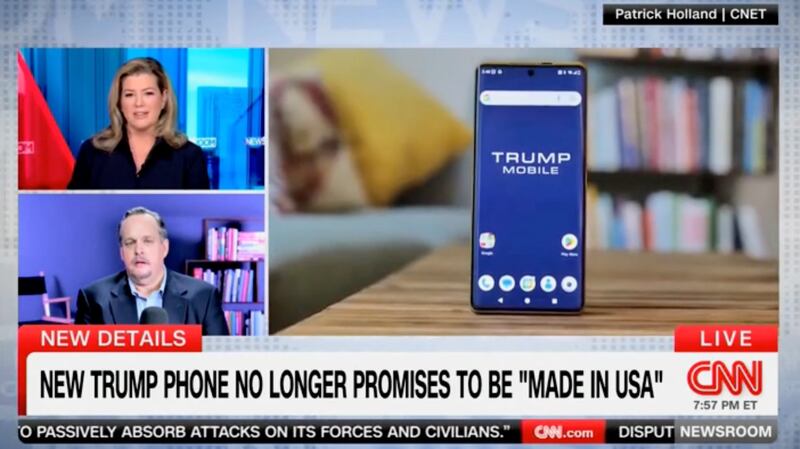
The long-delayed golden Trump Mobile phone looks nothing like the advertised image, has a smaller screen than promised, and its color leaves a lot to be desired, according to one of the few people to lay eyes on a real one.

The $500 Trump phone has now been delivered to tech media for review, one year after it was announced and nine months after its hard launch to cash-rich MAGA diehards.

Not only is the screen smaller than expected, but the phone is also not made in America as promised, Patrick Holland, the managing editor of tech site CNET, told CNN. Rather, Holland added, the packaging says the phone is “designed with American values in mind.”

Patrick Holland discusses the Trump Phone on CNN.
Patrick Holland discusses the Trump Phone on CNN. screen grab

Holland reviewed the phone on CNN on Monday after spending the day testing it, and the news was not good for customers.

Holland says the actual product looks “nothing like the original image” from last year, which he said resembled an “altered iPhone 16 Pro.”

Trump Mobile Phone Is Finally Released—With a Major BlunderMADE IN CONFUSION

Martha McHardy

trump mobile

The tech expert ripped into the phone’s selling point, criticizing the “gold” coloring in honor of Trump’s favorite thing.

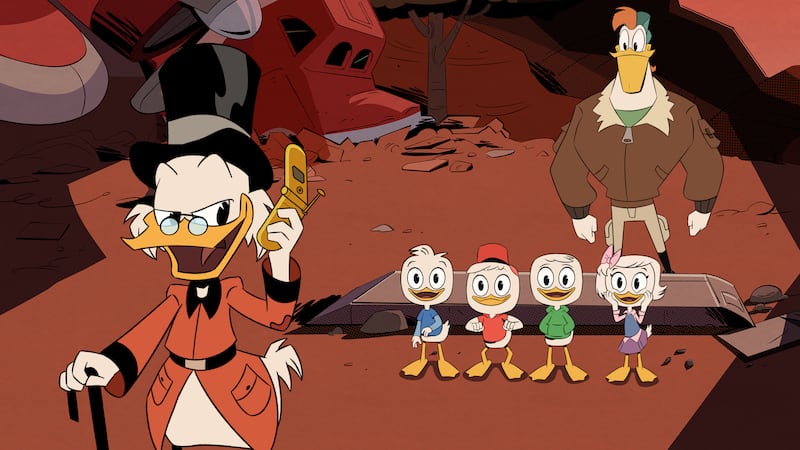
“Sometimes it looks like those gold coins that Scrooge McDuck would jump into for DuckTales,” Holland said of the Disney character bathing in his riches.

Donald Duck reluctantly takes his nephews Huey, Dewey and Louie to the home of their reclusive great-uncle Scrooge McDuck.
Scrooge McDuck on a phone, not a Trump Phone. Disney XD/Disney XD via Getty Images

“Other times, it’s got a mustard vibe to it, and yet other times, it kind of looks like a urine sample.”

The CNET unboxing video also reveals that the American flag etched into the phone has 11 stripes, instead of 13. It comes with an old-school headphone jack and has Truth Social pre-installed. The camera also automatically filters selfies.

President Donald Trump speaks with workers who have been painting the Lincoln Memorial Reflecting Pool in Washington, DC, on May 7, 2026. Workers have been resurfacing the bottom of Washington's famous Lincoln Memorial Reflecting Pool with "American flag blue"-colored material used in swimming pools, following an order by US President Donald Trump. (Photo by Kent NISHIMURA / AFP via Getty Images)

Holland said he would not recommend the phone to customers due to the unknown technical construction of the $500 item.

“We don‘t know what the processor is in the phone. We don‘t know what the software and security updates will be,” Holland said

He also said he has a “big worry” about whether the Trump Phone will actually ship to people who paid for it.

“While a couple of us in the media do have it, I can‘t find many cases of actual customers who put their money down to order the phone with the phone.”

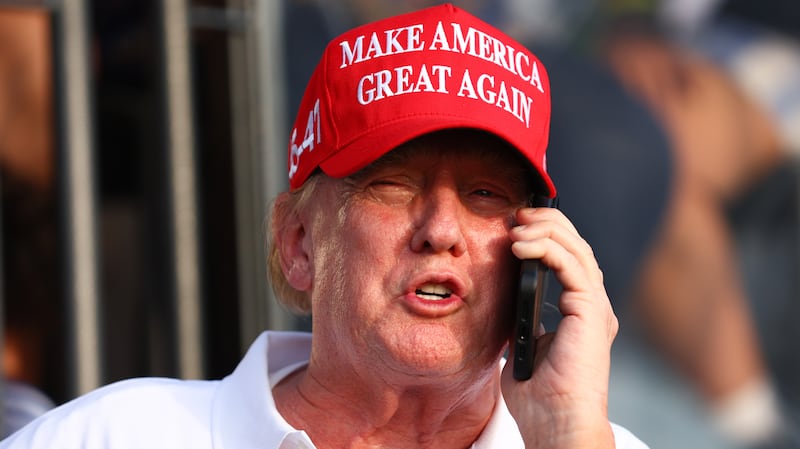
President Donald Trump is regularly seen with his phone and frequently posts on his platform, Truth Social.
This entry was posted in TRUMP on May 26, 2026 by sterlingcooper.

JP MORGAN CHASE SUED FOR $5 BILLION FOR DE-BANKING TRUMP AND HIS COMPANIES!

Trump sues JPMorgan Chase and CEO Jamie Dimon for $5B over alleged ‘political’ debanking

The lawsuit claims JPMorgan’s decision ‘came about as a result of political and social motivations’ to ‘distance itself’ Trump and his ‘conservative political views’

President Donald Trump joins Maria Bartiromo to discuss ongoing negotiations that would give the U.S. total access to Greenland, citing national and global security concerns.

FIRST ON FOX: President Donald Trump is suing JPMorgan Chase and its CEO Jamie Dimon in a $5 billion lawsuit filed Thursday, accusing the financial institution of debanking him for political reasons.

The president’s attorney, Alejandro Brito, filed the lawsuit Thursday morning in Florida state court in Miami on behalf of the president and several of his hospitality companies.

Brito quotes JPMorgan’s code of conduct, which states that the bank operates “with the highest level of integrity and ethical conduct.”

JP Morgan Chase HQ

The JPMorgan Chase & Co. headquarters in Park Avenue, Midtown, Manhattan, New York.  (Tim Clayton/Corbis via Getty Images / Getty Images)

TRUMP SAYS HE WILL SUE JPMORGAN CHASE OVER ‘INCORRECT’ POST-JAN 6 DEBANKING

“We set high expectations and hold ourselves accountable. We do the right thing—not necessarily the easy or expedient thing. We abide by the letter and spirit of the laws and regulations everywhere we do business and have zero tolerance for unethical behavior,” the lawsuit states, citing the bank’s code of conduct.

“Despite claiming to hold these principles dear, JPMC violated them by unilaterally—and without warning or remedy—terminating several of Plaintiff’s bank accounts,” the lawsuit claims.

A JPMorgan Chase spokesperson told Fox News Digital Thursday, “While we regret President Trump has sued us, we believe the suit has no merit. We respect the President’s right to sue us and our right to defend ourselves – that’s what courts are for.

“JPMC does not close accounts for political or religious reasons,” she continued, “We do close accounts because they create legal or regulatory risk for the company. We regret having to do so but often rules and regulatory expectations lead us to do so.  We have been asking both this administration and prior administrations to change the rules and regulations that put us in this position, and we support the Administration’s efforts to prevent the weaponization of the banking sector.”

Trump had been a customer of JPMorgan for decades, and he and his affiliated entities “have transacted hundreds of millions of dollars” through JPMorgan Chase, according to the lawsuit.

Trump’s lawyer said Feb. 19, 2021, was the day that “forever altered the dynamic of the parties’ relationship,” when the bank, allegedly “without warning or provocation,” notified Trump and his entities that several bank accounts they controlled, were beneficiaries of, and actively used to transact “would be closed just two months later, on April 19, 2021.”

Bank executive speaks to an audience during a conference focused on business and innovation.

Jamie Dimon, chief executive officer of JPMorgan Chase & Co., speaks during the America Business Forum in Miami, Nov. 6, 2025. (Eva Marie Uzcategui/Bloomberg via Getty Images / Getty Images)

“JPMC did not provide plaintiffs with any recourse, remedy, or alternative—its decision was final and unequivocal,” the lawsuit claims.

Trump’s attorney said they are “confident that JPMC’s unilateral decision came about as a result of political and social motivations, and JPMC’s unsubstantiated, ‘woke’ beliefs that it needed to distance itself from President Trump and his conservative political views.”

“In essence, JPMC debanked plaintiff’s accounts because it believed that the political tide at the moment favored doing so,” the lawsuit states. “In addition to the considerable financial and reputational harm that Plaintiffs and their affiliated entities suffered, JPMC’s reckless decision is leading a growing trend by financial institutions in the United States of America to cut off a consumer’s access to banking services if their political views contradict with those of the financial institution.”

Trump and JP Morgan Chase logo split

President Donald Trump had been a customer of JPMorgan for decades, according to the lawsuit.  (Krisztian Bocsi/Bloomberg via Getty Images; Angela Weiss/AFP via Getty Images)

Trump’s attorney alleged that, “JPMC’s conduct, in violation of its code of conduct and Dimon’s lofty assertions, is a key indicator of a systemic, subversive industry practice that aims to coerce the public to shift and re-align their political views.”

The lawsuit goes on to allege that JPMorgan Chase and Dimon have “unlawfully and unjustifiably published some or all of their names, including the names of President Trump, the Trump Organization with its affiliated entities, and the Trump family, on a

blacklist.”

The blacklist, according to the lawsuit, allegedly is accessible by federally regulated banks and is comprised of individuals and entities that have a history of malfeasant acts and are otherwise noncompliant with applicable banking rules and regulations.

“Given that Plaintiffs have always complied with all applicable banking rules and regulations and their wealth management accounts were in good standing, JPMC’s publication of President Trump, the other Plaintiffs, the Trump Organization and its affiliated entities, and/or the Trump family’s names on this blacklist, is an intentional and malicious falsehood,” the lawsuit states, alleging that JPMorgan Chase engaged in “an unfair and deceptive trade practice” by directing the publication of the names to the list, noting that the bank “had no legitimate basis to do so and knew that doing so would induce, and did in fact induce, other banking institutions not to deal with them.”

Trump is accusing JPMorgan Chase and Dimon of trade libel, violating Florida’s unfair and deceptive trade practices act, declaratory relief, and breach of implied covenant of good faith and fair dealing.

Trump’s team is demanding a jury trial.

President Donald Trump

President Donald Trump’s team is demanding a jury trial. (Getty Images)

The president teased the lawsuit in a Truth Social post over the weekend.

“I’ll be suing JPMorgan Chase over the next two weeks for incorrectly and inappropriately DEBANKING me after the January 6th Protest, a protest that turned out to be correct for those doing the protesting,” Trump said in a Truth Social post. “The Election was RIGGED!”

Trump has publicly said in interviews that JPMorgan Chase gave him a deadline, reportedly 20 days, to move hundreds of millions of dollars and effectively severed his accounts after Jan. 6, 2021. He also said Bank of America later refused to accept large deposits when he attempted to bank elsewhere.

In a previous statement to Fox, JPMorgan Chase spokesperson Trish Wexler said, “Serving more than 80 million Americans is our privilege, and we agree that no one’s account should ever be closed because of political or religious beliefs. We appreciate that this administration has moved to address political debanking, and we support those efforts.”

Dimon in 2025 denied that the bank debanks conservatives or customers based on political views.

“We don’t debank people because of political or religious affiliations,” Dimon said on Capitol Hill Feb. 13, 2025. “But there are a lot of things that can be fixed. We should fix them. The rules and requirements are so onerous, and it does cause people to be debanked in my opinion, should not be debated.”

When asked whether banking regulators were primarily to blame for debanking concerns, Dimon replied, “Pretty much, yeah.”

Bank of America CEO Brian Moynihan, who also has faced scrutiny from the White House over debanking allegations, offered a similar response in a separate interview that day.

“We have 70 million customers, and we’re happy to serve anyone,” Moynihan said.

Trump Tower

In 2025, the Trump Organization sued Capital One after it allegedly “unjustifiably” terminated more than 300 of the company’s bank accounts and accounts belonging to numerous Trump family members in 2021.  (Leonardo Munoz/VIEWpress / Getty Images)

When pressed on Trump’s allegations, Moynihan declined to elaborate in 2025, saying, “You’d have to talk to him about that, thanks.”

In 2025, the Trump Organization sued Capital One after it allegedly “unjustifiably” terminated more than 300 of the company’s bank accounts and accounts belonging to numerous Trump family members in 2021.

On March 8, 2021, Capital One allegedly notified Trump and the plaintiffs that hundreds of bank accounts that they controlled, were beneficiaries of and actively used would be closed June 7, 2021. According to the lawsuit, Capital One did not provide Trump and the plaintiffs with any “recourse, remedy, or alternative — its decision was final.”

The accounts affiliated with the Trump Organization held millions of dollars belonging to them and their affiliated entities.

At the time, a Capital One spokesperson told Fox News Digital that: “Capital One has not and does not close customer accounts for political reasons.”

This entry was posted in TRUMP on January 22, 2026 by sterlingcooper.

THE TRUMP STORE IN PHILLY, PLANS TO CLOSE…

Trump Store to Close as Sales Falter, With No Election Battles Ahead

The shop in suburban Philadelphia had been a gathering spot for the MAGA crowd to rally during the 2024 campaign.

Mike Domanico standing in his store with T-shirts and banners emblazoned with photos and slogans supporting President Trump hanging behind him.
Mike Domanico, the owner of a store that sells Trump merchandise in Bensalem, Pa., said it was time to close its doors.Credit…Hannah Beier for The New York Times

Nestled in a strip mall in suburban Philadelphia, The Trump Store is hard to miss with its all-caps sign in bold next to a photo of President Trump hugging the American flag. But after six years of drawing MAGA supporters from all over, the 800-square-foot store that sports everything from hats and watches emblazoned with the president’s name is closing.

The store’s owner, 56-year-old Mike Domanico, said that, with sales down, it was time.

“He’s not running again,” Mr. Domanico said of the president, who is barred from seeking a third term by the Constitution. “When something’s happening like an election’s coming up or something in the news happens with Trump, the sales jump. But since there’s no election coming up, things have slowed down.”

The Trump store was stocked with stuffed animals, T-shirts, hats and the works. Credit…Hannah Beier for The New York Times

By the time Mr. Domanico decided to close the store on Jan. 31, he was making roughly 30 sales per day — just a fraction of what he once earned.

He recalled making about 100 sales per day in the months leading up to the 2024 presidential election, and roughly double or triple that amount when the store first opened to immense demand in February 2020, when Mr. Trump was seeking re-election after his first term.

“I did very well for the store for six years and it’s just time to move on for me,” he said. The store owner said he wanted to focus on his other businesses, including selling gun-related items.

The store, in Bensalem, Pa., was a magnet for the Make America Great Again crowd. Large numbers of the politically like-minded gathered in its parking lot for pro-Trump rallies leading up to the 2024 presidential election.

“It was a place that you could go to sing and dance and celebrate Trump,” said Bobbie Murphy, who frequented the store and its rallies. She added, “It put Bensalem on the map. They came from everywhere for that store.”

Ms. Murphy, a real estate agent in Bensalem, has collected 50 to 100 pieces of Trump merchandise over the years, including shirts, hats, stuffed animals and tree ornaments.

“We think small. We don’t think big,” like the president, she said.

Adam Berinsky, a political science professor at the Massachusetts Institute of Technology and director of the MIT Political Experiments Research Lab, said that kind of loyalty is why he would warn against viewing the store’s closure as a sign that the president’s core base was faltering — even if he’s unpopular with the general public.

Yphtach Lelkes, an associate professor of communications at the University of Pennsylvania, similarly said that the president’s most loyal supporters are unlikely to leave him. But the decline in sales could signal less enthusiasm among more casual Trump backers who might think twice before sporting a MAGA hat in public.

“It’s not only what you believe, but what you perceive other people believe,” he said. “So if you’re a Trump supporter and you can increasingly see people around you dislike him, it’s going to be riskier to go around donning that signal.”

Image

A woman shops for pro-Trump gear, like decals and coffee mugs.
Kathy Knowles shopping at the store on Thursday.Credit…Hannah Beier for The New York Times

Mr. Trump’s approval rating is mired at 42 percent, according to a New York Times polling average. The only presidency this century that had a lower approval rating at this point in a term was also Mr. Trump’s, during his first term.

Mr. Domanico said he has been a Trump supporter since the 1980s. He admired Mr. Trump’s ambition and success as a real estate developer, and watched “The Apprentice” religiously.

In 2019, he was a general contractor and selling T-shirts at local car shows when someone requested he make Trump T-shirts. He brought about 20 Trump T-shirts to the next car show, and sold out in about half an hour. He began setting up a “Trump 2020” tent in front of his office once a week where he peddled more Trump gear.

“Immediately it was a hit,” he said.

Once a week soon became daily. He moved the growing business to a kiosk at Neshaminy Mall, several miles down the road from the closing brick-and-mortar store, for a couple months before finding its final home at the strip mall, which also features Latin American and Chinese eateries as well as an African goods store.

Image

A store front in a strip mall with a rack of T-shirts and banners and signs that promote President Trump.
The Trump Store in Bensalem, Pa., outside Philadelphia is scheduled to close on Jan. 31.Credit…Hannah Beier for The New York Times

“It took me a couple months to find somewhere, because as soon as I said Trump store to any of the landlords, they were like no way, we don’t want any problems with our building,” Mr. Domanico said.

The store opened in February 2020 to fanfare among conservatives in the swing county with lines out the door. He sold out in the first week.

“It was nuts from the very beginning and one thing led to another and it was crazy and we had a lot of fun with it,” he said.

This entry was posted in TRUMP on January 16, 2026 by sterlingcooper.

Recent Posts

  • ANOTHER GOVERNMENT PROJECT WASTING MILLIONS AND NOBODY IS IN JAIL!
  • SOCIALISM ALWAYS BECOMES COMMUNISM, AND IT NEVER WORKED; INVENTED BY AN UNEMPLOYED GERMAN LOSER NAMED KARL MARX
  • PRESIDENT TRUMP RELEASES HIS 2025 INCOME!!!
  • HUMANOID ROBOTS PERFORM FIRST EVER SURGERY!
  • SENATOR LINDSEY GRAHAM, TRUMP’S BIGGEST SUPPORTER, DIES OF A HEART ATTACK AT AGE 71

Sterling Cooper, Inc. © 2023,  Privacy Policy